One of the most common frustrations in dementia care is this:
“They just won’t do it.”
“They’re being difficult.”
“They refuse everything.”
But what looks like dementia resistance vs ability is often misunderstood.
In many cases, it’s not refusal at all.
It’s a mismatch.
A mismatch between what’s being asked… and what the person is still able to do.
The Problem With How We Interpret Behavior
When someone doesn’t engage, we tend to assume:
- They don’t want to
- They don’t understand
- Or they’re no longer capable
So we either:
- Stop trying
- Oversimplify everything
- Or repeat the same approach, hoping it works
But what if the issue isn’t the person?
What if it’s the way the task is being presented?
A Different Way to Look at It
The Preserved Abilities Method™ starts with a simple shift:
Instead of asking, “Why won’t they do this?”
We ask, “What ability does this require—and do they still have it?”
Because even as dementia progresses, abilities don’t disappear all at once.
They change.
Some fade.
Some remain.
Some become even more dominant.
A Real-World Example
Imagine asking someone to participate in an activity using only verbal instructions:
“Do this… now try it this way…”
They don’t respond.
They disengage.
It’s easy to assume:
- They don’t understand
- They aren’t interested
- They are refusing
But what may actually be happening is this:
The task is being delivered verbally…
while the person’s verbal-linguistic ability has declined.
At the same time, they may still have strong bodily–kinesthetic ability—the ability to learn and engage through movement.
What Happens When We Shift the Approach
When the approach changes, the outcome changes.
Instead of explaining, the caregiver:
- Demonstrates the movement
- Encourages participation through action
- Allows the person to engage physically, not verbally
And suddenly, something different happens.
A Simple Example of This in Action
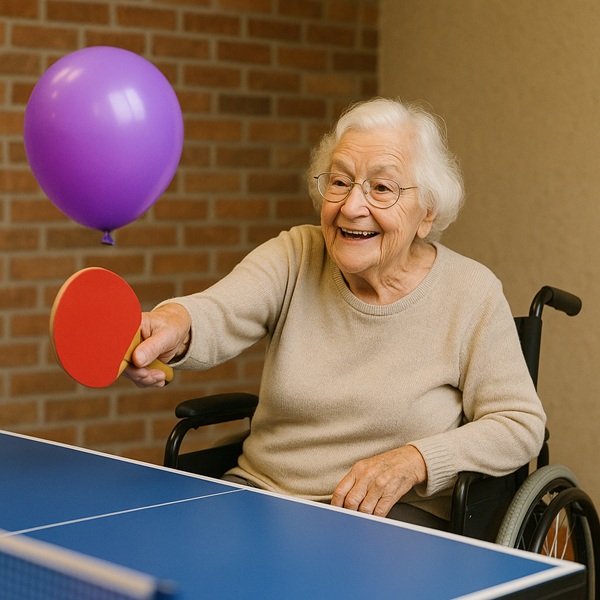
A person is engaged in a simple balloon activity—reaching, tapping, and interacting in the moment.
This type of activity may appear basic, but it reflects something important:
The task is aligned with what the person can still do.
It doesn’t rely on complex instructions.
It doesn’t require memory or language.
Instead, it taps into movement, timing, and interaction—abilities that often remain even as other skills decline.
And because of that, the result is:
- Engagement
- Enjoyment
- Success
This Is the Difference
Nothing about the person changed.
The ability was already there.
The approach simply matched it.
Why This Matters
When care is not aligned with preserved abilities, we often see:
- Frustration
- Withdrawal
- “Refusal” behaviors
- Loss of confidence
But when care is aligned with what remains:
- Engagement increases
- Communication improves
- Tasks become easier
- The person experiences success again
The Bigger Shift
This isn’t about doing less.
It’s not about lowering expectations.
It’s about changing how we support the person in meeting them.
Final Thought
Before assuming someone is unwilling…
Ask:
What ability does this task require?
And is there another way to access it?
Because often, the difference between resistance and engagement
is simply alignment.
Learn More
To learn more about how to identify and apply preserved abilities in daily care, visit:
👉 https://preservedabilities.com/