
Testimonials
The M.I. Care Survey and Plan™ is making a real difference. It helps practitioners reteach skills, improve outcomes, and even prevent unnecessary hospice referrals—while giving individuals living with dementia new confidence and quality of life.
Read the testimonials below to see how the M.I. Care Survey and Plan™ is changing lives for practitioners and those they serve:
The M.I. Care Survey and Plan™ is built on over 10 years of real-world use. Its developer, Matthew Call, gained recognition for helping individuals with dementia in remarkable ways — including a case featured on CBS News (Florida Affiliate) where he helped a man relearn to write by tapping into his preserved abilities.

My client often became aggressive and was difficult to redirect, refusing most activities. When she did try to participate, frustration quickly turned into anger. After completing the M.I. Care Survey, we discovered she still had strong linguistic-verbal abilities. The next time she became upset, I followed her plan and handed her a whiteboard and marker. She immediately calmed down, began writing, and remained peaceful for twenty minutes. She not only enjoyed writing — she was good at it. It was a skill I never would have guessed she still possessed.
When my mom moved into a memory care facility, she stopped eating and lost an unhealthy amount of weight. After several unsuccessful interventions by a nutritionist, a nursing supervisor even suggested hospice, saying her refusal to eat meant her body was shutting down. I was horrified — before entering the facility, she had no issues eating. Another family recommended a practitioner who used the M.I. Care Survey and Plan. I was skeptical, but willing to try. The Survey revealed that my mom’s strongest preserved ability was intrapersonal intelligence — she thrived in quiet, calm environments. This made sense, as she had always avoided large groups. That evening, she was given dinner in a quiet space away from the noisy dining room. To my amazement, she ate her entire meal. Now, whenever she’s provided with a peaceful setting, she continues to eat well. The M.I. Care Survey and Plan helped save my mom from an unnecessary hospice referral — and gave her health and dignity back
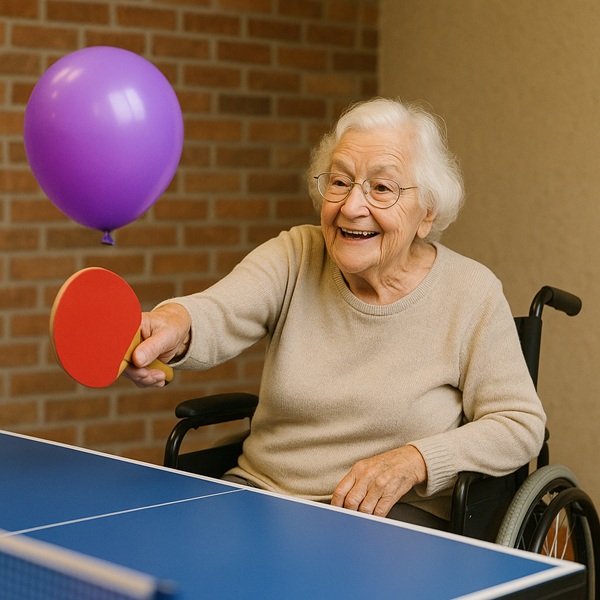
When my nonverbal mother began losing shoulder mobility, one
therapist dismissed her for not following verbal instructions. Another,
using the M.I. Care Survey and Plan, recognized her strong kinesthetic abilities. Because people with this strength communicate well through
movement, and drawing on her history as a tennis player, he built on that foundation. He introduced a balloon and paddle and, through handover-
hand guidance, she understood what the therapist wanted her to do. This simple but meaningful activity helped her regain movement and, most importantly, rediscover joy.
As my mom’s dementia has progressed, she has lost many skills and often avoids activities that only leave her feeling frustrated. After seeing a local news report about the M.I. Care Survey and Plan, I reached out to a practitioner who administered it. The Survey revealed that my mom still had strong linguistic-verbal abilities, and the practitioner encouraged us to focus on activities that tapped into that strength. I was overjoyed to see her light up when we introduced word games — not only could she do them, but she genuinely enjoys them. For the first time in a long while, she’s engaging in something that brings her both success and joy.
My nonverbal client had stopped feeding herself. Because she was unable to follow verbal directions or visual cues, staff assumed there was no way to communicate the task and began feeding her, which led to complete dependence. I didn’t want to rule out her ability without exploring alternative methods. A practitioner had recently conducted the M.I. Care Survey with her husband, which revealed strong bodily-kinesthetic abilities. Drawing on this, I used hand-over-hand communication — a bodily-kinesthetic strategy — to physically guide her through the motions of feeding. With practice, she began to understand the task again and was soon feeding herself independently.
As an activity director, I often struggled to engage groups of individuals since each person has unique preferences and abilities. The M.I. Care Survey and Plan has changed that. By identifying each client’s preserved abilities, I can design activities around the most common strengths in the group. For those whose abilities don’t align, I involve them in related tasks — like handing out materials for those with bodily-kinesthetic abilities — so everyone has a meaningful role. Since using the M.I. Care Survey and Plan, engagement has improved dramatically and attendance has grown, because every person feels included and successful.