
In dementia care, behaviors are often treated as problems to be managed.
Wandering. Repetition. Resistance. Withdrawal.
These responses are typically addressed through redirection, supervision, or environmental control. While these approaches may help in the moment, they don’t always address the underlying cause.
But what if these behaviors aren’t random?
What if they are a reflection of how the brain is still processing the world?
What Causes Behaviors in Dementia?
Many behaviors in dementia are commonly explained as symptoms of cognitive decline.
However, another perspective is gaining attention:
Behavior may be a response to how the individual is experiencing and processing their environment.
This includes:
- Sensory input (noise, light, touch)
- Communication (verbal and nonverbal)
- Environmental complexity
- Changes in routine or predictability
When the brain processes these inputs differently, behavior often becomes the most visible form of expression.
Are Dementia and Autism Related?
Dementia and autism are fundamentally different conditions.
Dementia is neurodegenerative, involving progressive changes over time.
Autism is neurodevelopmental and present across the lifespan.
However, in some cases, individuals in both populations may show similarities in how they process and respond to their environment.
These may include:
- Sensitivity to sensory input
- Difficulty processing complex language
- Preference for routine or predictability
- Overwhelm in busy or unstructured environments
This is not a diagnostic overlap—it is a functional observation.
And it matters, because it can help guide more effective care.
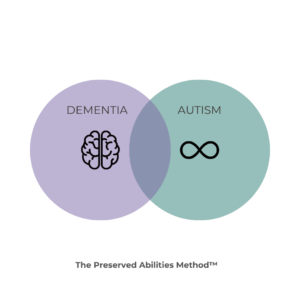
How the Brain Processes the Environment in Dementia
When behaviors are viewed only as symptoms, the focus often becomes how to stop them.
But when behavior is understood as a response to processing, a different question emerges:
What is the person experiencing in this moment?
For example:
- A person who is “wandering” may not be disoriented.
They may have a preserved need for movement or spatial engagement. - Repetitive speech may reflect retained rhythm or language patterns.
- Resistance to care may indicate confusion, overwhelm, or difficulty interpreting verbal instructions.
- Withdrawal may be a response to overstimulation rather than disengagement.
In this context, behavior is not random.
It is often the most accessible way the individual is interacting with their environment.
Why Understanding Processing Improves Dementia Care
When care shifts from managing behavior to understanding processing, several things begin to change:
- Communication becomes more effective
- Environments can be adjusted to reduce stress
- Activities can be aligned with retained abilities
- Frustration decreases for both the individual and caregiver
Most importantly, care becomes more person-centered.
Instead of focusing only on what has been lost, attention shifts to what remains—and how it can be used to support daily life.
A Strength-Based Approach to Dementia Care
The Preserved Abilities Method™ is built on this perspective.
It provides a structured way to:
- Identify which abilities are still intact
- Understand how those abilities influence behavior
- Align care strategies to support those strengths
This approach moves care from guesswork to clarity—helping both families and professionals respond more effectively.
Conclusion: Behavior Is Not Random
The question is no longer just how to respond to behavior.
It is whether we are accurately interpreting what the behavior represents.
In many cases, behavior is not the problem to solve—
it is the signal to understand.
Learn More
If you’re supporting someone living with dementia—whether as a professional or a family caregiver—understanding preserved abilities can provide a clearer path forward.
👉 Learn more about how to identify these abilities using the M.I. Care Survey and Plan™:
https://preservedabilities.com/