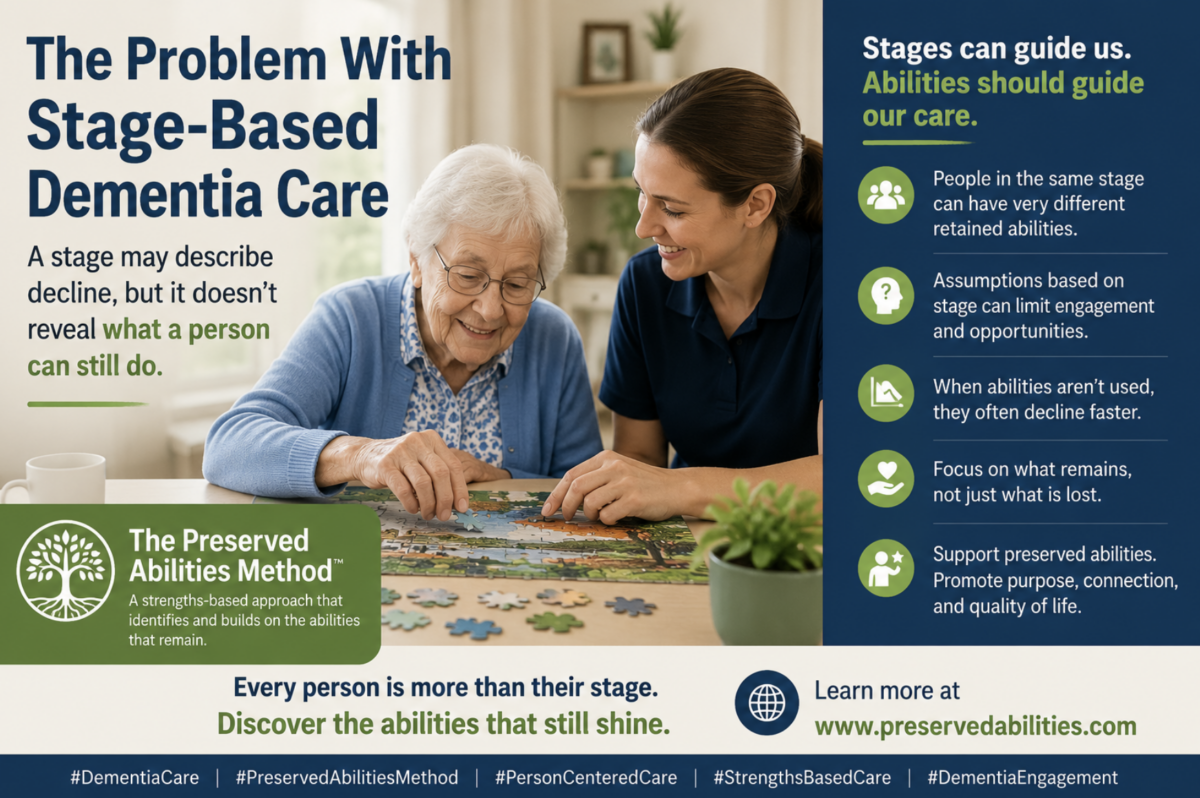
A dementia stage may describe decline, but it doesn’t reveal all of a person’s remaining abilities.
For decades, dementia care has relied heavily on stages to help explain disease progression. Stages can be useful. They provide a general framework for understanding changes in memory, communication, and daily function.
But what if our reliance on stages is causing us to overlook something important?
What if the stage doesn’t tell the whole story?
The Problem With Assumptions
One of the most common assumptions in dementia care is that people who are in the same stage of dementia have similar abilities.
In reality, anyone who has spent significant time with people living with dementia knows this isn’t always true.
Two individuals may be considered to be in the same stage of dementia, yet their retained abilities can look completely different.
One person may no longer be able to read but can still spend an hour tending a garden.
Another may struggle to follow conversations but can sing every word of songs learned decades ago.
A third may require assistance with most daily tasks yet still enjoy organizing tools, folding laundry, or helping others.
The stage may be the same.
The abilities are not.
When Stages Become Expectations
The challenge isn’t necessarily the stage itself.
The challenge is what happens when the stage becomes an expectation.
When caregivers, professionals, or family members assume a person cannot participate in certain activities because of their stage, opportunities for engagement can disappear.
A favorite hobby may no longer be offered.
Meaningful responsibilities may be taken away.
Activities that once brought joy may be discontinued because they are assumed to be “too difficult.”
The assumption becomes the limitation.
The Hidden Cost
Perhaps the greatest concern is that abilities often decline when they are no longer used.
Most of us understand this principle.
If we stop exercising, our muscles weaken.
If we stop practicing a skill, our proficiency decreases.
The same can be true for many preserved abilities in dementia.
When opportunities to engage are removed, opportunities to practice those abilities are removed as well.
The result may be a loss of function that was not inevitable, but rather the consequence of no longer being given the chance to use it.
A Different Question
Traditional approaches often begin by asking:
“What has this person lost?”
While that question is important, it may not be the most important question.
The Preserved Abilities Method™ begins somewhere else.
It asks:
“What abilities remain?”
Instead of focusing exclusively on deficits, the Preserved Abilities Method™ identifies retained strengths across eight areas of functioning and uses those strengths to guide communication, activities, environmental design, and daily support.
This shift in perspective changes everything.
Rather than assuming what a person cannot do, we begin discovering what they still can do.
Rather than removing opportunities, we create them.
Rather than defining someone by decline, we support them through their strengths.
The Person Behind the Diagnosis
Dementia affects every individual differently.
No stage, diagnosis, or assessment can fully capture a person’s unique combination of retained abilities, interests, experiences, and strengths.
That’s why person-centered care requires more than understanding decline.
It requires understanding the individual.
The next time you find yourself wondering what someone living with dementia can no longer do, consider asking a different question:
“What abilities might still be there?”
The answer may surprise you.
Learn more about the Preserved Abilities Method™ at:
https://www.preservedabilities.com
#DementiaCare #AlzheimersCare #PersonCenteredCare #PreservedAbilitiesMethod #DementiaActivities #CaregiverSupport #MemoryCare #SeniorCare #AgingWell #DementiaEducation #StrengthsBasedCare #MICareSurveyandPlan