
When people think about dementia care, they often focus on communication strategies, safety concerns, or managing behaviors.
But one important factor is frequently overlooked:
The environment itself.
For individuals living with dementia, the environment around them can have a major impact on how they feel, function, communicate, and engage with others.
And in many cases, environments that align with a person’s preserved abilities may help them feel calmer, safer, more confident, and more emotionally secure.
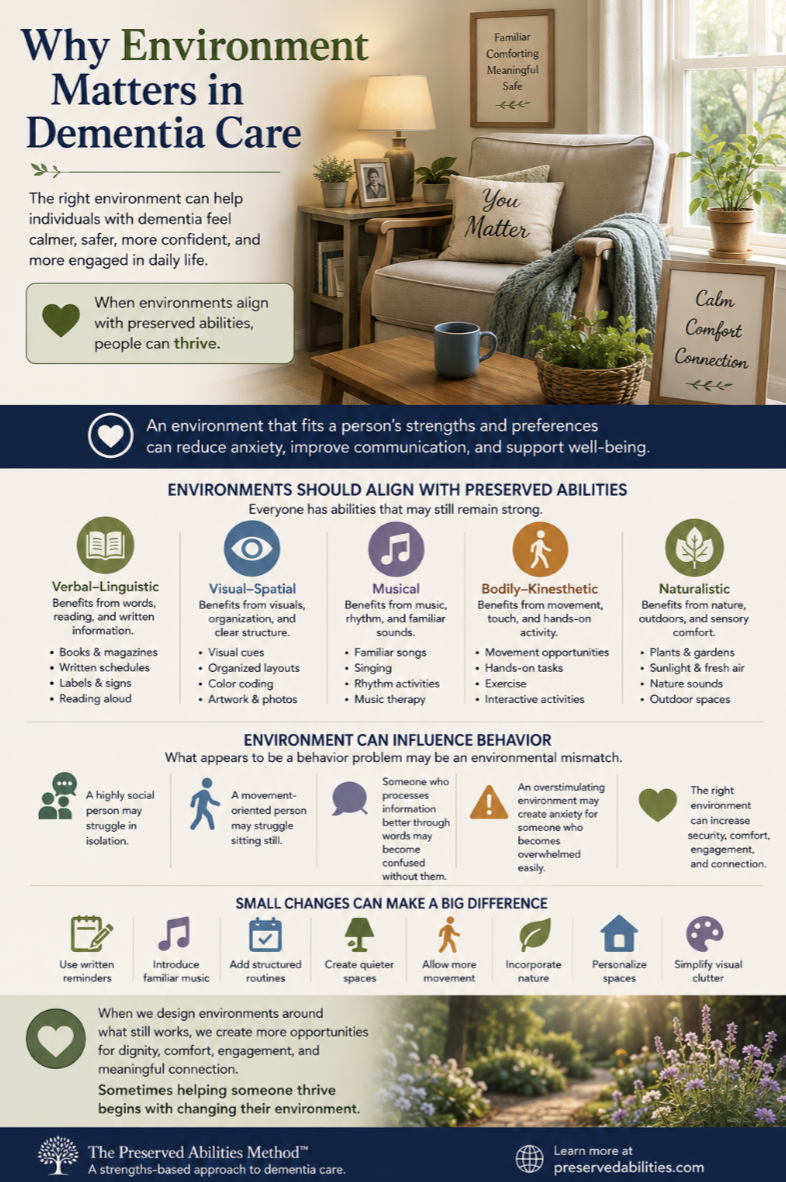
Why Environment Matters
All of us naturally feel more comfortable in environments that align with how we process and interact with the world.
For example, someone who loves reading may feel calm and at ease in a library. The quiet atmosphere, organized shelves, written information, and familiar structure naturally align with their interests and strengths.
Someone who enjoys music may feel more relaxed and emotionally connected in an environment filled with familiar songs or rhythmic activity.
Someone who enjoys movement and hands-on activity may feel restless sitting in a quiet room all day—but feel more comfortable in an environment where movement is encouraged.
These preferences do not suddenly disappear because someone develops dementia.
In many cases, important abilities and preferences may still remain—even when memory or verbal communication decline.
The Problem With One-Size-Fits-All Dementia Environments
Many dementia care environments are designed around general safety and efficiency, but not necessarily around preserved abilities.
As a result, some individuals may feel:
- overstimulated
- under-stimulated
- confused
- disconnected
- frustrated
- emotionally withdrawn
An environment that feels calming and supportive to one person may feel overwhelming or uncomfortable to another.
This is one reason why generic dementia approaches do not always work equally well for everyone.
What Are Preserved Abilities?
The Preserved Abilities Method™ focuses on identifying abilities that may still remain strong despite cognitive decline.
These preserved abilities can often still influence:
- communication
- emotional connection
- engagement
- routines
- comfort
- environmental preferences
Some examples include:
Verbal–Linguistic Ability
Individuals with stronger verbal-linguistic ability may respond well to:
- written schedules
- books and magazines
- labels and signs
- word games
- reading aloud
Visual–Spatial Ability
Some individuals may feel more comfortable in environments with:
- visual cues
- organized layouts
- color coding
- meaningful artwork
- clear visual structure
Musical Ability
Music can sometimes help create:
- emotional connection
- familiarity
- calmness
- improved participation
- reduced anxiety
Bodily–Kinesthetic Ability
Some individuals may thrive when environments allow:
- movement
- hands-on activity
- pacing safely
- exercise
- interactive tasks
Naturalistic Ability
Nature-based environments may help support:
- relaxation
- sensory comfort
- emotional well-being
- meaningful engagement
This may include:
- plants
- outdoor spaces
- gardens
- sunlight
- nature sounds
Environment Can Influence Behavior
Sometimes what appears to be a “behavior problem” may actually reflect an environmental mismatch.
For example:
- A highly social individual may become distressed in isolation.
- A movement-oriented person may struggle sitting still for long periods.
- Someone who processes information better through words may become confused when only visual cues are used.
- An overstimulating environment may create anxiety for someone who becomes overwhelmed easily.
When environments better align with preserved abilities, people may feel more:
- secure
- understood
- engaged
- emotionally regulated
- connected to the world around them
Small Changes Can Make a Big Difference
Creating an ability-aligned environment does not necessarily require major renovations or expensive equipment.
Sometimes small adjustments can make meaningful differences, such as:
- using written reminders instead of only pictures
- introducing familiar music
- adding structured routines
- creating quieter spaces
- allowing more movement opportunities
- incorporating nature and sensory comfort
- simplifying visual clutter
- personalizing activity areas
The goal is not perfection.
The goal is creating environments that work with the person instead of against them.
A Different Way to Think About Dementia Care
Too often, dementia care focuses almost entirely on loss.
But many individuals living with dementia still retain important abilities, preferences, emotional responses, and ways of interacting with the world.
When we begin designing care environments around what still works, we create more opportunities for:
- dignity
- comfort
- engagement
- emotional well-being
- meaningful connection
Sometimes helping someone thrive begins with changing the environment around them.
About The Preserved Abilities Method™
The Preserved Abilities Method™ is a strengths-based dementia care approach that focuses on identifying abilities that may still remain and using those insights to guide communication, engagement, activities, and environmental support.
Learn more at preservedabilities.com