One of the most common challenges in dementia care is how we interpret behavior.
When someone begins repeating words, making sounds, or communicating in ways that don’t seem clear, it’s often labeled as “behavior.”
Something to manage.
Something to redirect.
Something to stop.
But what if we looked at it differently?
A Different Way to See Behavior
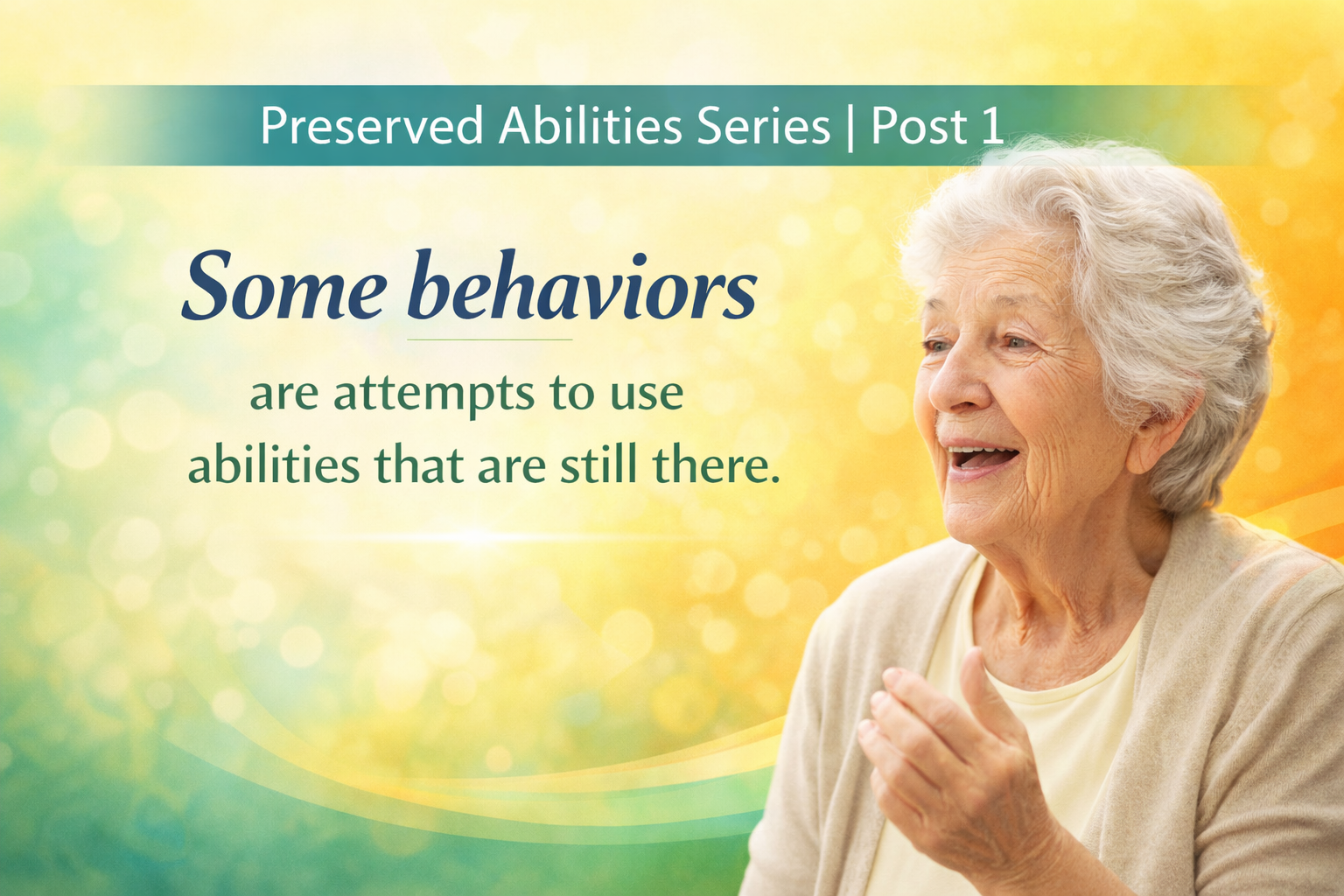
Some behaviors are attempts to use abilities that are still there.
In many cases, what we are seeing is not random.
It is a person trying to use what still works.
Even as dementia progresses, certain abilities often remain:
- The ability to respond to rhythm and tone
- The ability to engage through language patterns
- The ability to connect through sound and repetition
These are preserved abilities.
And when we don’t recognize them, we risk misunderstanding what the person is trying to do.
Example: Repeating Words or Sounds
Repetition is one of the most commonly misunderstood behaviors in dementia care.
A person may:
- repeat the same word or phrase
- make consistent sounds
- echo what others say
This is often seen as something to interrupt or correct.
But in many cases, repetition reflects something else:
👉 The person is still able to access rhythm and language.
Instead of asking:
“How do I stop this?”
Try asking:
“How can I use this?”
Using What Remains
When repetition is viewed through the lens of preserved abilities, the response changes.
You might:
- respond using the same words or rhythm
- turn repetition into a simple back-and-forth interaction
- match tone, pace, or sound
- engage instead of redirect
What looks repetitive can become interactive.
What sounds like noise can become connection.
Why This Matters
When behavior is misunderstood, it often leads to:
- frustration
- disconnection
- unnecessary redirection
But when behavior is recognized as an attempt to use preserved abilities:
- communication improves
- engagement increases
- interactions become more meaningful
The person hasn’t stopped communicating.
They’ve just changed how they communicate.
The Takeaway
Some behaviors are attempts to use abilities that are still there.
When we begin to recognize those abilities, we stop reacting to behavior—and start responding to the person.
And that shift changes everything.
What’s Next in This Series
In future posts, we’ll explore other common behaviors and what they may represent, including:
- Wandering → movement and bodily-kinesthetic ability
- “Interrupting” → interpersonal connection
- Agitation → overstimulation and internal processing
If you’re looking for a structured way to identify preserved abilities and use them to guide care, the M.I. Care Survey and Plan™ provides a clear, step-by-step approach.