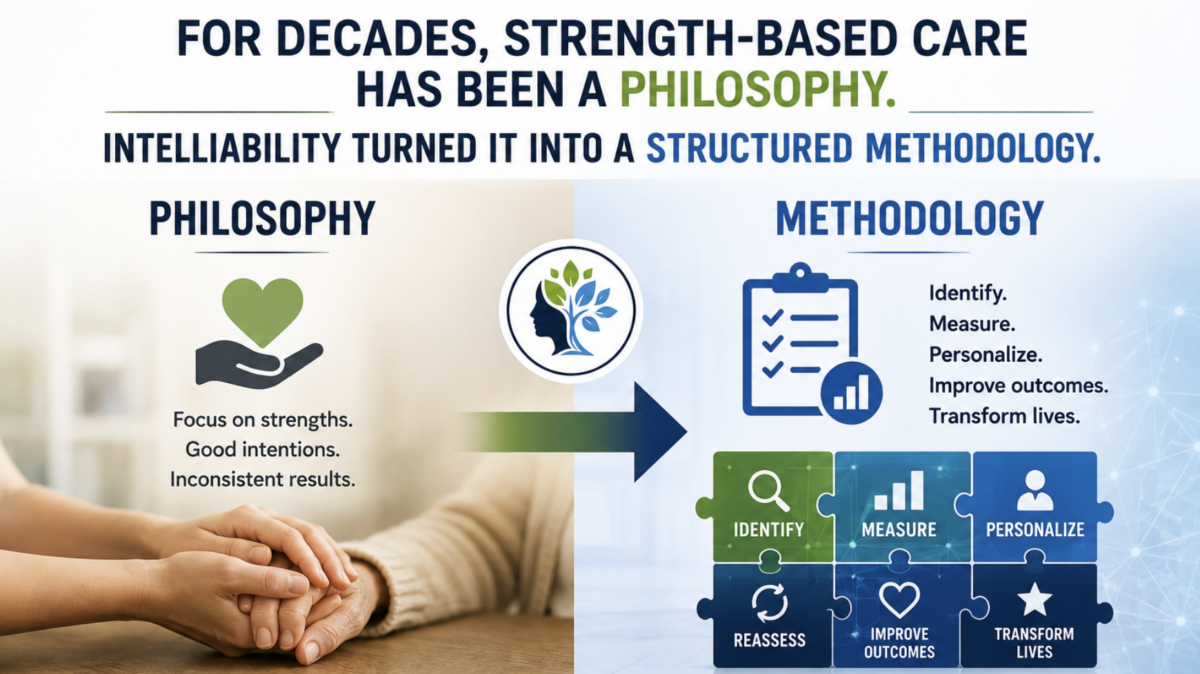
Strength-based dementia care has evolved from a guiding philosophy toward a structured methodology for identifying and building on preserved abilities.
What if the next evolution in dementia care isn’t another philosophy—but a structured way to put existing philosophies into practice?
For decades, strength-based dementia care has transformed the way we think about supporting people living with dementia.
Instead of focusing exclusively on what has been lost, strength-based care encourages us to recognize what remains. It reminds us that people living with dementia continue to possess abilities, preferences, relationships, and opportunities for meaningful engagement.
At IntelliAbility, we wholeheartedly embrace that philosophy.
In fact, we believe it represents one of the most important advances in dementia care.
But we also believed there was an important question that had not yet been fully answered.
How do you consistently put that philosophy into practice?
How do you systematically identify a person’s preserved abilities?
How do you measure them?
And once you know what those preserved abilities are, how do you consistently translate them into individualized care?
Those questions became the foundation of everything IntelliAbility set out to build.
Philosophy Inspires. Methodology Guides.
A philosophy tells us what we should value.
A methodology tells us how to consistently put those values into practice.
Many dementia care approaches encourage caregivers to focus on strengths, preserve dignity, and provide person-centered support.
Those principles have transformed dementia care for the better.
However, relatively few approaches include a structured assessment specifically designed to identify and measure preserved abilities before individualized care strategies are developed.
In many settings, strengths are identified through observation, conversations with families, staff experience, and trial and error. Those approaches can provide valuable insights, but they often vary from one caregiver to another and can be difficult to standardize.
At IntelliAbility, we believed there was another step.
Rather than simply encouraging caregivers to “focus on strengths,” we asked a different question:
What if preserved abilities could be systematically identified before care decisions were made?
That simple question led to the development of the Preserved Abilities Method™.
Building on an Established Scientific Foundation
The Preserved Abilities Method™ did not begin with a blank sheet of paper.
Its scientific foundation is the pioneering work of Harvard cognitive scientist Dr. Howard Gardner and his Theory of Multiple Intelligences.
Dr. Gardner’s research fundamentally changed how the world understands human intelligence by demonstrating that intelligence extends far beyond traditional measures of IQ. His theory has influenced education, psychology, and human development for decades.
At IntelliAbility, we asked another question:
Could Dr. Gardner’s framework become the foundation for a structured methodology that helps caregivers better understand people living with dementia?
Rather than creating a new theory of human abilities, IntelliAbility developed a methodology that applies the Theory of Multiple Intelligences to dementia care through a structured assessment, individualized care planning, and practical caregiving strategies.
This work was later recognized by Dr. Gardner himself when he published IntelliAbility’s work on his M.I. Oasis blog as an example of expanding the application of Multiple Intelligences beyond education.
For IntelliAbility, that recognition reinforced our belief that Dr. Gardner’s theory could become more than an educational framework—it could become the scientific foundation for a new methodology in dementia care.
Turning Theory into Practice
The answer became the M.I. Care Survey and Plan™.
Built upon Dr. Gardner’s Theory of Multiple Intelligences, the assessment systematically identifies preserved abilities across eight domains.
Those findings are then translated into individualized recommendations for:
- Communication strategies
- Environmental modifications
- Meaningful activities
- Daily caregiving approaches
Instead of beginning with the question:
“What has this person lost?”
the methodology begins with a different question:
“What abilities are still preserved?”
Once those abil
ities are identified, caregivers can individualize care around what the person can still do—not simply compensate for what has been lost.
That shift changes everything.
From Philosophy to Methodology
Many Strength-Based Approaches
- ✓ Focus on strengths
- ✓ Person-centered philosophy
- Structured assessment: Limited
- Systematically measures preserved abilities: Rare
- Individualized communication strategies: Varies
- Environmental recommendations: Varies
- Activity recommendations: Varies
- Assessment-driven methodology: Rare
The Preserved Abilities Method™
- ✓ Focuses on strengths
- ✓ Person-centered philosophy
- ✓ Structured assessment
- ✓ Systematically measures preserved abilities
- ✓ Individualized communication strategies
- ✓ Environmental recommendations
- ✓ Activity recommendations
- ✓ Assessment-driven methodology
This comparison is not intended to diminish the many valuable approaches that have advanced dementia care. Person-centered care, Montessori-based dementia programming, and many other strength-based models have made important contributions to improving the lives of people living with dementia.
Rather, it highlights the specific contribution IntelliAbility set out to make:
Transforming the philosophy of strength-based dementia care into a structured, assessment-driven methodology.
As we often say:
A philosophy tells us what to do.
A methodology tells us how to do it consistently.
Recognition Beyond Education
One of the most meaningful milestones in IntelliAbility’s journey came when Dr. Howard Gardner published IntelliAbility’s work on his M.I. Oasis blog as an example of expanding the application of Multiple Intelligences beyond education.
That recognition was significant because it demonstrated that the Theory of Multiple Intelligences could extend beyond the classroom into dementia care.
While Dr. Gardner developed the scientific foundation, IntelliAbility demonstrated how that framework could become the basis of a practical, assessment-driven methodology that helps caregivers systematically identify preserved abilities and translate those findings into individualized care.
Since then, IntelliAbility’s work has also been featured by Newsweek, further highlighting a methodology built on identifying what remains—not simply documenting what has been lost.
Why This Matters
Too often, dementia care begins with deficits.
We document impairments.
We describe limitations.
We respond to behaviors.
Those steps may be necessary.
But they should not be where care begins.
Imagine if every care plan started by systematically identifying what remained.
Imagine if every caregiver understood a person’s preserved abilities before deciding how to communicate, engage, or provide support.
Imagine how differently care might look.
That was the vision that inspired IntelliAbility to develop the Preserved Abilities Method™.
Today, families and professionals deserve more than a philosophy.
They deserve a methodology that helps them consistently translate strengths into better care.
A New Chapter for Strength-Based Dementia Care
Strength-based dementia care changed the conversation.
IntelliAbility’s goal has been to help change the practice.
By combining the scientific foundation of Dr. Howard Gardner’s Theory of Multiple Intelligences with a structured, assessment-driven methodology, the Preserved Abilities Method™ provides caregivers with a systematic way to identify preserved abilities and transform those findings into individualized care.
We believe the future of dementia care begins with a different question.
Not:
“What has this person lost?”
But:
“What abilities are still preserved?”
Because when we begin there:
- Communication changes.
- Relationships change.
- Engagement changes.
- Care changes.
- Lives change.
At IntelliAbility, we didn’t set out to replace the philosophy of strength-based dementia care.
We set out to make it measurable.
We set out to make it repeatable.
We set out to make it practical.
We set out to build a methodology that helps caregivers consistently recognize, measure, and build upon the preserved abilities that remain.
Because philosophies inspire us.
Methodologies transform practice.
And transforming practice is how we improve lives.
Learn More
To learn more about the Preserved Abilities Method™ and how IntelliAbility is helping families and professionals identify what remains—not simply what has been lost—visit: