What If They’re Not Being Disruptive?
One of the most common things I hear in dementia care settings is:
“She keeps approaching visitors.”
“He follows people around all day.”
“She always sits down with other families when they’re visiting.”
“He keeps trying to join groups and conversations.”
These behaviors are often described as intrusive, disruptive, attention-seeking, or inappropriate.
As a result, the focus frequently becomes finding ways to redirect the person or stop the behavior altogether.
But what if we’re looking at it the wrong way?
What if the behavior isn’t the problem?
What if it’s a preserved ability trying to express itself?
Looking Beyond the Label
Imagine a person living with dementia who regularly approaches visitors when they enter a community.
They may sit beside visiting families, smile at them, observe their interactions, or simply remain nearby.
Sometimes they speak.
Sometimes they don’t.
In many cases, verbal communication may be significantly impaired.
Yet they continue seeking out people.
From a traditional perspective, the behavior may appear intrusive.
From a strengths-based perspective, however, something entirely different may be happening.
The person may have strong preserved interpersonal abilities.
Connection Doesn’t Require Words
When people hear the term interpersonal ability, they often think of conversation.
But interpersonal ability is much broader than that.
It is the desire and capacity to connect with other people.
Some individuals connect through conversation. Others connect through smiles, eye contact, gestures, laughter, touch, facial expressions, or simply by choosing to be near others.
Even when dementia affects language, the need for human connection often remains.
In some individuals, that need remains remarkably strong.
The Need Behind the Behavior
Now consider what that person’s day may look like.
Perhaps they spend long periods sitting alone.
Perhaps staff members are busy providing care.
Perhaps opportunities for meaningful interaction are limited.
Perhaps family visits are infrequent.
Then suddenly, visitors arrive.
People are laughing.
Talking.
Sharing stories.
Connecting.
For someone whose preserved abilities are centered around relationships and social engagement, those visitors may represent exactly what has been missing throughout the day.
Not because they are seeking attention.
But because they are seeking connection.
A Different Question
In dementia care, we often ask:
“How do we stop this behavior?”
A more helpful question may be:
“What ability is trying to express itself?”
That simple shift can completely change our approach.
Instead of focusing solely on redirection, we begin looking for ways to support the preserved ability.
If interpersonal ability appears strong, we might consider:
- Increasing opportunities for meaningful social interaction.
- Encouraging participation in small-group activities.
- Creating peer companionship opportunities.
- Involving the person in welcoming others.
- Offering purposeful roles that involve interaction and engagement.
- Scheduling more meaningful connection throughout the day.
The goal shifts from managing behavior to supporting human needs.
Finding the Ability Behind the Behavior
The Preserved Abilities Method™ encourages caregivers to look beyond what a person has lost and focus on the abilities that remain.
Many behaviors commonly associated with dementia may actually be attempts to use preserved strengths.
The resident who seeks out every visitor may not be disruptive.
The resident who follows staff throughout the day may not be attention-seeking.
The resident who always wants to sit where other people are gathered may not simply be wandering.
They may be demonstrating that connection still matters.
That relationships still matter.
That being around people still matters.
Final Thoughts
Not every behavior is a problem to be solved.
Sometimes it is a strength searching for an outlet.
The next time someone is described as disruptive, intrusive, or attention-seeking, consider pausing before reacting.
Ask a different question.
What if they’re not being disruptive?
What if they’re simply trying to use an ability that is still there?
The challenge may not be eliminating the behavior.
The challenge may be finding a more meaningful way for that preserved ability to be expressed.
To learn more about the Preserved Abilities Method™ and strength-based dementia care, visit preservedabilities.com.
#DementiaCare #AlzheimersCare #StrengthBasedCare #PersonCenteredCare #Aging #SeniorCare #Caregiving #MemoryCare #DementiaAwareness #PreservedAbilitiesMethod #FindTheAbilityBehindTheBehavior #MICareSurveyandPlan #HealthcareInnovation #LongTermCare #HomeCare #CarePartners #MeaningfulEngagement #QualityOfLife
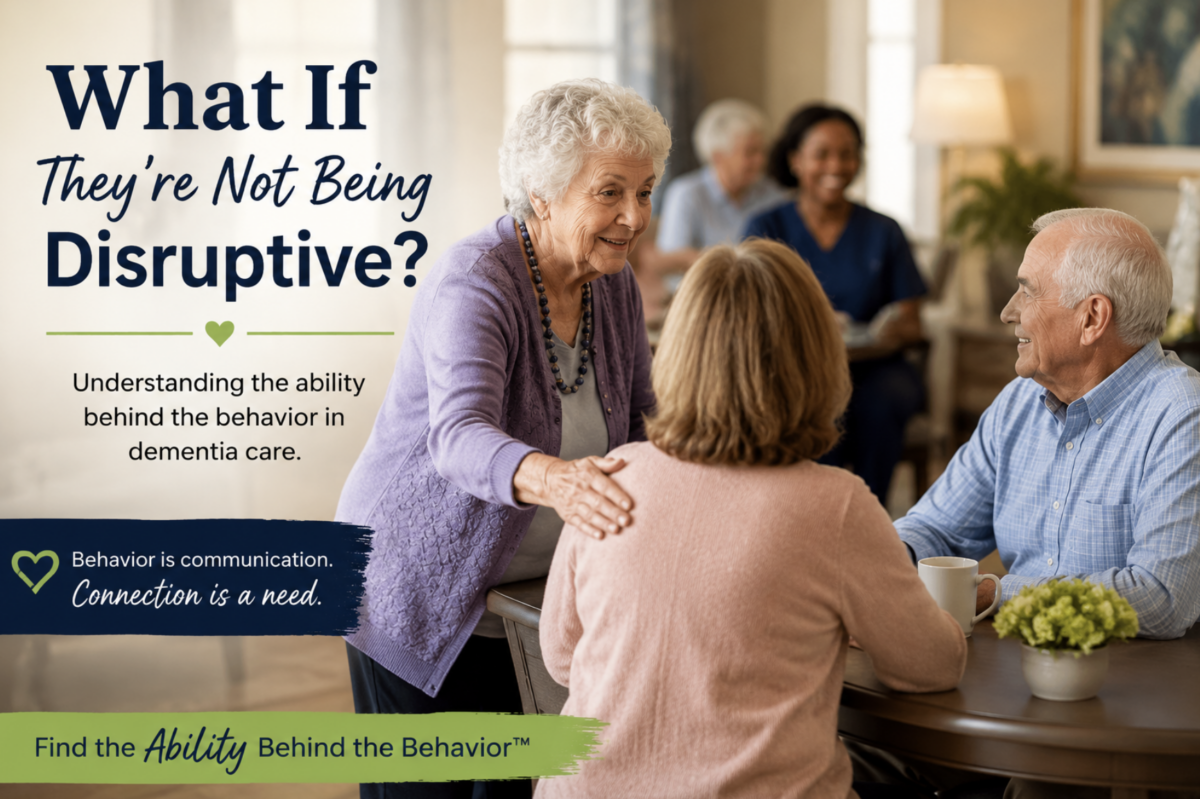
Some behaviors labeled as “disruptive” may actually be expressions of preserved interpersonal abilities and a need for human connection.