Throughout my 25 years of experience working with individuals living with dementia, I have seen the same situation play out time and time again.
A family member or professional caregiver presents an activity to someone living with dementia. The person struggles with it, becomes frustrated, shows little interest, or simply walks away.
The caregiver may try again with a different activity and receive a similar response.
Eventually, a conclusion is reached.
“They don’t enjoy activities anymore.”
Or perhaps:
“Their dementia has progressed to the point where they can no longer participate in activities.”
While these conclusions are understandable, they are often based on a misunderstanding of what is actually happening.
What the caregiver may be observing is not a complete loss of interest or ability.
What they may be observing is a person who can no longer successfully complete a specific activity.
There is an important difference.
When an Activity Becomes Too Difficult
Imagine being repeatedly asked to do something you know you are expected to enjoy, but no longer have the ability to do successfully.
Most people would eventually stop trying.
Not because they no longer wanted to participate.
Not because they no longer enjoyed being engaged.
But because repeated failure is discouraging.
Many activities require specific cognitive abilities to be successful. As dementia progresses, some abilities may decline while others remain accessible.
A person may be given:
- A complex puzzle they can no longer complete
- A word search that is now too difficult to follow
- A craft project requiring multiple steps
- A book they can no longer comfortably read
- A game with rules they can no longer remember
When they struggle, become frustrated, or refuse to participate, caregivers often assume they have lost interest in activities.
But what if the activity itself is the problem?
What if the person is not rejecting engagement?
What if they are rejecting frustration?
Unfortunately, caregivers often witness this withdrawal and conclude that the person is no longer interested in activities or no longer capable of participating.
In reality, the person may still have a strong desire for engagement, purpose, accomplishment, social interaction, and meaningful involvement in daily life.
They simply need opportunities that align with the abilities that remain.
Failure in One Activity Does Not Mean Failure in All Activities
One of the greatest mistakes we can make is assuming that failure in one activity means failure in all activities.
A person who can no longer complete a crossword puzzle may still respond beautifully to music.
A person who struggles with reading may still enjoy conversation, storytelling, or helping others.
A former accountant may no longer be able to balance a checkbook but may still enjoy sorting, organizing, categorizing, or identifying patterns.
Someone who can no longer complete a complex craft project may still find success folding laundry, gardening, walking, setting a table, or participating in familiar routines.
The issue is not always that the person has lost the ability to engage.
Sometimes the activity simply no longer matches the abilities that remain.
Dementia does not typically erase all abilities at once.
While some abilities decline, others often remain accessible far longer than families and professionals expect.
The challenge is identifying those remaining abilities and finding meaningful ways to use them.
The Hidden Consequences
When caregivers repeatedly offer activities that are too difficult, several things often happen.
The individual experiences failure and frustration.
The caregiver becomes discouraged.
Activities are offered less frequently.
Engagement opportunities begin to disappear.
Over time, the person may experience:
- Less cognitive stimulation
- Less social interaction
- Less physical activity
- Fewer opportunities to experience success
- Fewer opportunities to use preserved abilities
This can create a cycle in which disengagement is mistaken for decline, when the real issue may have been a poor match between the activity and the person’s strengths.
The Goal Is Not to Keep Someone Busy
Too often, activity programming focuses on finding something to do.
The real goal should be helping someone continue using the abilities that are still there.
The right activity can lead to engagement, confidence, enjoyment, purpose, and success.
The wrong activity can lead to frustration, withdrawal, and the mistaken belief that the person is no longer capable of participating.
The goal is not simply to find an activity.
The goal is to find an activity that allows the person to experience success.
A Different Way to Think About Dementia Care
This challenge is one of the reasons I developed the Preserved Abilities Method™.
For years, I watched families and professionals struggle to understand why one activity worked while another failed. Too often, the assumption was that the person could no longer participate because of their dementia.
What was often overlooked was that many abilities were still present.
The Preserved Abilities Method™ takes a different approach.
Rather than focusing primarily on what has been lost, it helps identify abilities that may still be present and provides practical ways to build communication, activities, environments, and support strategies around those strengths.
Because when we understand a person’s preserved abilities, we can stop guessing.
We can stop assuming that a failed activity means a lack of interest.
We can stop assuming that difficulty with one activity means inability across all activities.
Instead, we can begin creating more opportunities for engagement, participation, confidence, and success.
We can help people remain engaged.
We can help people continue participating in meaningful ways.
And we can help ensure that the abilities that remain continue to be used and supported for as long as possible.
The goal is not to keep someone busy.
The goal is to help them continue using the abilities that are still there.
To learn more about the Preserved Abilities Method™ and the M.I. Care Survey & Plan™, visit https://preservedabilities.com.
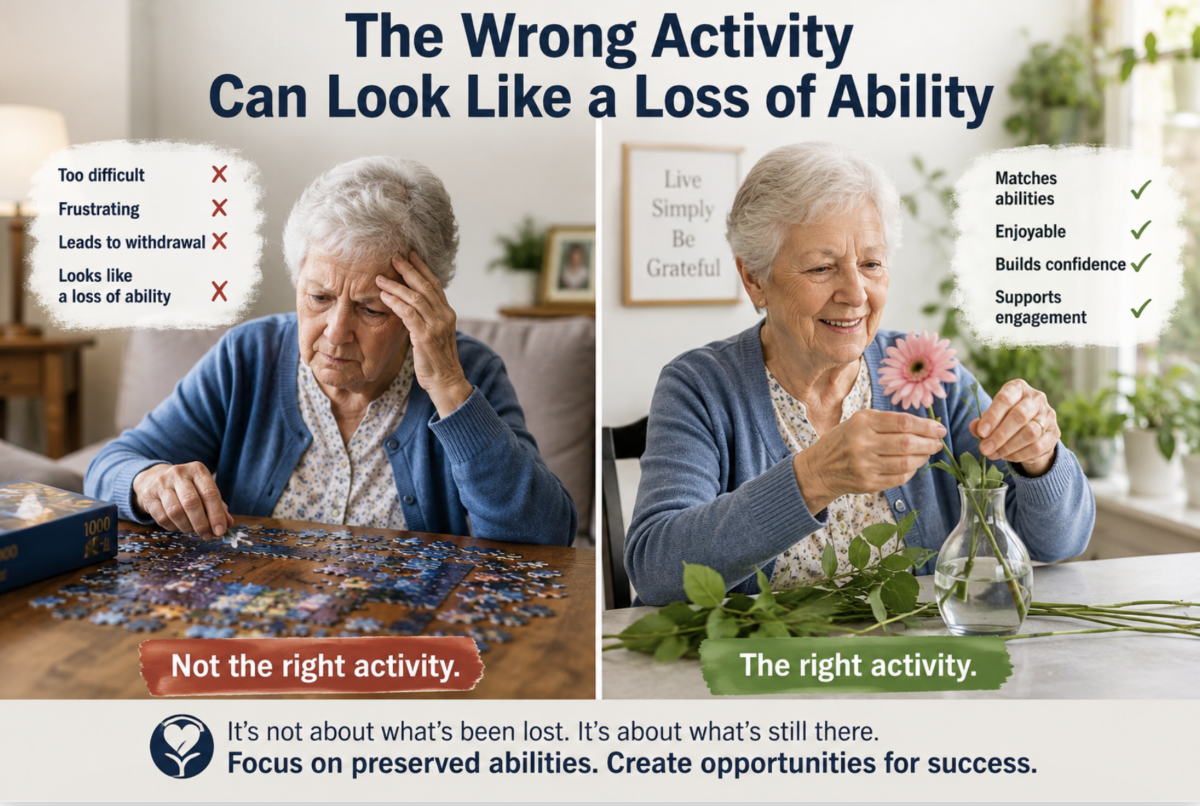
A person’s difficulty with one activity does not mean they have lost the ability to engage. Activities that align with preserved abilities often lead to greater participation and success.