
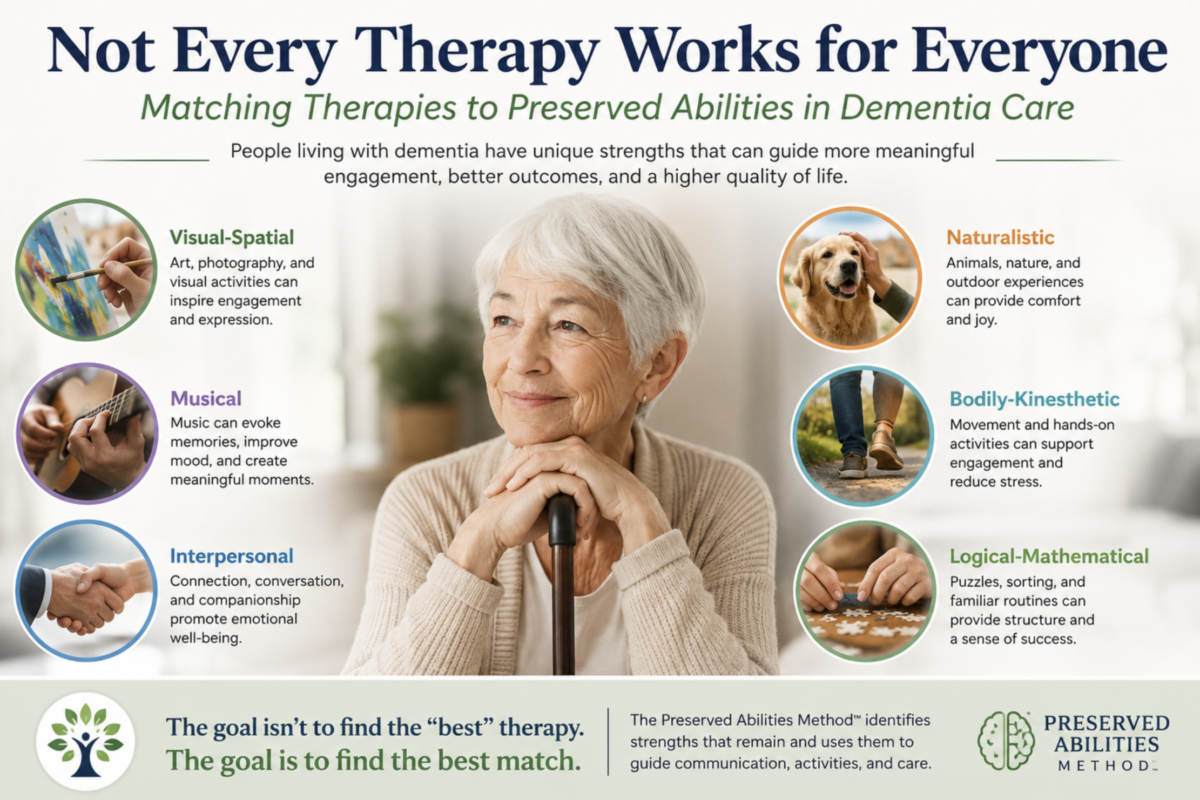
The most effective dementia interventions often align with a person’s preserved abilities rather than using the same approach for everyone.
Walk into almost any dementia care setting and you’ll see a variety of therapeutic approaches being used. Music therapy, art therapy, pet therapy, sensory activities, exercise programs, and reminiscence groups all have their place in dementia care.
But there is one important question we don’t ask often enough:
What if the therapy itself isn’t the most important factor?
What if the key is matching the therapy to the person’s preserved abilities?
One of the biggest misconceptions in dementia care is the idea that a single therapeutic approach should work equally well for everyone. Anyone who has spent significant time supporting individuals living with dementia knows this simply isn’t the case.
Some individuals come alive when music begins to play.
Others couldn’t care less about music but become deeply engaged when given paint, photographs, or visual projects.
Others seem uninterested in either but immediately connect when a dog enters the room.
The difference may not be motivation.
The difference may be preserved abilities.
Looking Beyond the Diagnosis
Dementia affects every person differently. While memory and cognitive function change over time, not all abilities decline at the same rate.
Some individuals continue to demonstrate strong visual-spatial abilities. Others retain strong musical abilities. Some maintain a strong connection to nature, animals, movement, social interaction, or language.
The challenge is that many therapeutic programs are delivered broadly rather than individually.
As a result, we often conclude that a person “doesn’t enjoy activities” when the reality may be that we simply haven’t found the right pathway to engagement.
Art Therapy and Visual-Spatial Ability
Consider two individuals living with dementia.
One becomes highly engaged when working with photographs, colors, artwork, and visual projects. They notice details in their surroundings and respond well to demonstrations and visual cues.
For this person, art therapy may be incredibly meaningful because it aligns with a preserved visual-spatial ability.
Another individual may show little interest in these activities. That doesn’t mean they are unwilling to participate. It may simply mean that visual-spatial processing is no longer one of their strongest preserved abilities.
Music Therapy and Musical Ability
We often hear stories about people living with dementia remembering song lyrics long after other memories have faded.
Music can be powerful.
But not everyone responds to music in the same way.
Individuals with strong musical abilities may become more alert, engaged, emotional, and communicative when music is incorporated into care.
Others may enjoy listening but show limited change in participation.
Again, the difference may not be the therapy itself. The difference may be the individual’s preserved abilities.
Pet Therapy and Naturalistic Ability
Many people living with dementia show a strong connection to animals, nature, gardening, weather, and outdoor environments.
For these individuals, pet therapy may feel natural and comforting.
A visit from a therapy dog may create engagement that no structured activity could achieve.
Likewise, time spent outdoors, caring for plants, or observing nature may be more effective than many traditional activity programs.
The reason is simple.
The intervention is aligning with a preserved ability that remains meaningful.
The Goal Isn’t Finding the “Best” Therapy
The goal is finding the best match.
No therapy is universally effective.
No activity works for everyone.
The most successful approaches often begin by identifying how a person naturally engages with the world and then building support around those strengths.
This is one of the core principles behind the Preserved Abilities Method™.
Rather than starting with a specific intervention and hoping it works, we begin by identifying preserved abilities and then selecting communication approaches, environmental modifications, and activities that align with those strengths.
When we do that, engagement often becomes easier, more meaningful, and more sustainable.
A Different Way to Think About Therapy
Perhaps the question isn’t:
“Which therapy is best for people living with dementia?”
Perhaps the better question is:
“Which therapy is best for this person?”
That shift may seem small.
But it can completely change the way we approach care.
Learn more about the Preserved Abilities Method™ at:
#DementiaCare #PreservedAbilitiesMethod #PersonCenteredCare #DementiaActivities #MusicTherapy #ArtTherapy #PetTherapy #CaregiverSupport #AlzheimersCare #MICareSurveyandPlan