One of the most common misconceptions about dementia is that once a skill is lost, it is gone forever.
Over the years, I have heard countless people say things like:
“Once the brain is damaged, there’s no getting it back.”
“They can’t learn anymore.”
“There’s no point in trying.”
While dementia certainly creates challenges with learning and memory, my experience has taught me that the answer is often more complicated.
Several years ago, I worked with a gentleman living with vascular dementia who had lost the ability to write.
Like many people living with dementia, he had experienced significant changes in his cognitive functioning. Writing, a skill most of us take for granted, had become extremely difficult.
Rather than focusing solely on what he could no longer do, we focused on what abilities remained.
Using repetition, support, and principles consistent with a learning approach known as errorless learning, we worked to gradually rebuild the skill.
Over time, he was able to write again.
His journey was later featured in a local news story and remains one of the most powerful examples I have witnessed of the brain’s ability to continue learning despite the challenges of dementia.
More importantly, the experience taught me something that would eventually shape the development of the Preserved Abilities Method™:
Before we teach a skill, we should first identify the abilities that remain.
What Is Errorless Learning?
Errorless learning is a teaching approach designed to maximize success and minimize mistakes during the learning process.
Rather than expecting a person to learn through trial and error, the instructor provides enough support to help the individual perform the task correctly from the beginning.
The idea is simple.
Every successful repetition strengthens learning.
Every unnecessary failure can create frustration and interfere with the learning process.
Research has shown that errorless learning can help some individuals living with dementia improve performance on specific tasks, maintain important routines, and in some cases relearn previously lost skills.
The Missing Piece
While errorless learning can be extremely effective, I believe there is an important question that is often overlooked:
How does this person learn best?
Too often, we assume everyone should be taught in the same way.
In reality, people living with dementia continue to retain different strengths and abilities.
If we want to maximize success, we should not only focus on what we are teaching.
We should also focus on how we are teaching it.
This is where preserved abilities become critically important.
Not Everyone Learns the Same Way
The Preserved Abilities Method™ is based on Howard Gardner’s Theory of Multiple Intelligences and recognizes that people often retain different strengths despite cognitive decline.
Understanding those strengths can help us determine the most effective teaching approach.
Logical-Mathematical Ability
Individuals with preserved logical-mathematical abilities often respond well to structure and sequence.
When teaching a skill, they may benefit from:
- Step-by-step instructions
- Checklists
- Predictable routines
- Clear sequences
For these individuals, learning becomes easier when information is organized and systematic.
Visual-Spatial Ability
Individuals with preserved visual-spatial abilities frequently learn best through observation.
Rather than relying primarily on verbal instruction, it may be more effective to:
- Demonstrate the task
- Model each step
- Use visual cues
- Provide pictures or diagrams
Sometimes seeing is far more effective than hearing.
Musical Ability
Individuals with strong musical abilities may benefit from rhythm, melody, and repetition.
Music can be incorporated into learning through:
- Rhythmic prompts
- Songs
- Familiar melodies
- Repetitive musical cues
Music often remains accessible long after other abilities begin to change.
Bodily-Kinesthetic Ability
Some individuals learn best through movement and hands-on participation.
These individuals may benefit from:
- Hand-over-hand assistance
- Physical guidance
- Repetition through action
- Learning by doing
The more actively involved they are, the more successful learning may become.
Errorless Learning and Preserved Abilities
Errorless learning focuses on reducing mistakes.
The Preserved Abilities Method™ focuses on identifying strengths.
Together, they can create a powerful framework for learning.
A person with strong logical-mathematical abilities may respond best to structured instructions.
A person with visual-spatial abilities may learn best through demonstration.
A person with musical abilities may respond to rhythm and song.
A person with bodily-kinesthetic abilities may learn best through hands-on practice.
The goal is not simply to teach.
The goal is to teach in a way that aligns with the person’s remaining abilities.
An Important Note
Not every individual living with dementia will be able to relearn every skill. Outcomes vary based on many factors, including the type of dementia, disease progression, overall health, and the complexity of the task being taught.
The purpose of this article is not to suggest that all lost abilities can be regained. Rather, it is to highlight the growing body of evidence supporting errorless learning and the importance of identifying preserved abilities when teaching or supporting individuals living with dementia.
In my experience, people living with dementia are often capable of more than we expect when instruction is tailored to their remaining strengths and provided in a supportive, person-centered manner.
Focusing on Possibility
Too often, dementia care focuses exclusively on decline.
While it is important to acknowledge challenges, it is equally important to recognize potential.
The lesson from the gentleman who relearned how to write was not simply that he regained a skill.
The lesson was that someone first took the time to identify what abilities remained and used those abilities as the foundation for learning.
The question may not be whether a person living with dementia can learn.
The question may be whether we are teaching in a way that matches the abilities they still possess.
Learn more about the Preserved Abilities Method™ at:
#DementiaCare #ErrorlessLearning #PreservedAbilitiesMethod #DementiaEducation #MemoryCare #AlzheimersCare #CaregiverSupport #PersonCenteredCare #OccupationalTherapy #StrengthsBasedCare
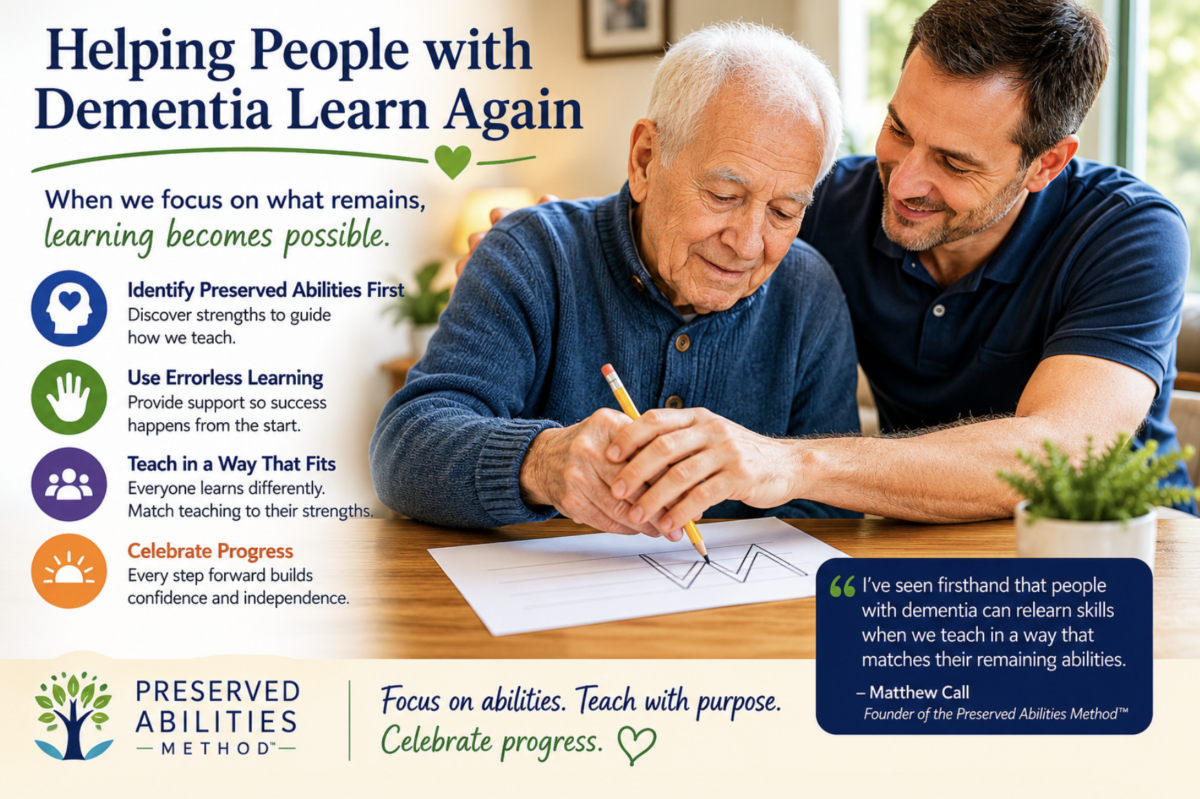
Identifying preserved abilities and using errorless learning may help some individuals living with dementia maintain or relearn important skills.