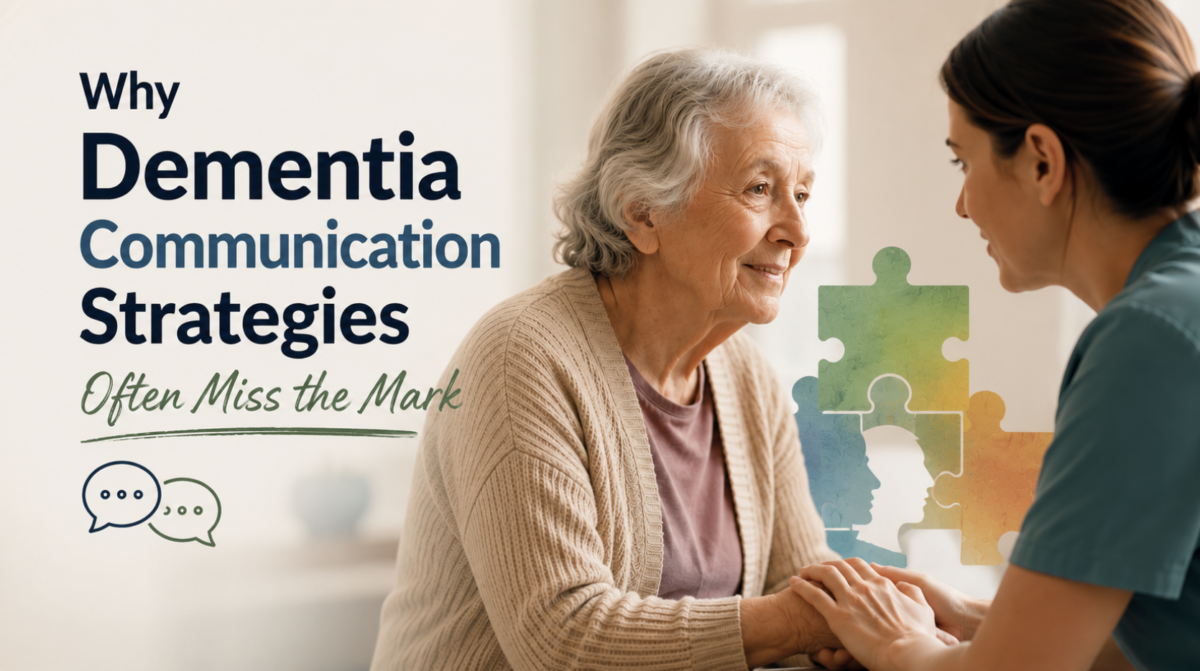
Effective dementia communication begins with understanding the individual, not just the diagnosis.
If you’ve spent any time in dementia care, you’ve probably heard the same communication advice repeated countless times.
Speak slowly.
Use simple language.
Ask one question at a time.
Avoid arguing.
Validate emotions.
Reduce distractions.
These are all valuable recommendations, and I encourage caregivers to use them. Yet despite decades of education and training, communication remains one of the greatest challenges for families and professionals caring for someone living with dementia.
Why?
Because communication is about more than what we say.
It’s also about how another person is still able to receive, process, and respond to information.
The Problem Isn’t That We Need More Communication Strategies
When communication doesn’t go as planned, it’s easy to assume we need another technique.
Maybe we need to speak slower.
Maybe we need to simplify our words even more.
Maybe we need to redirect differently.
Sometimes those adjustments help.
Sometimes they don’t.
The reason is simple: many communication strategies are taught as though they should work equally well for everyone living with dementia.
But dementia doesn’t affect everyone the same way.
Every person brings a unique personality, life experience, pattern of cognitive change, and set of preserved abilities.
If people are different, why would we expect the same communication approach to work for everyone?
Dementia Is Personal. Communication Should Be Too.
Over the years, I’ve worked with hundreds of individuals living with dementia and their families.
One lesson has become increasingly clear:
The strategies themselves are often not the problem.
The problem is assuming the same strategy should work for every person.
I’ve watched caregivers become discouraged because they faithfully applied the communication techniques they were taught, only to find that their loved one continued to become frustrated, withdrawn, or resistant.
The caregiver wasn’t failing.
The communication simply wasn’t individualized.
Why Guessing Isn’t Enough
One of the biggest misconceptions in dementia care is that we can identify a person’s strengths simply by observing them or knowing a little about their history.
While experience and intuition certainly have value, assumptions can also lead us down the wrong path.
Someone may appear to communicate one way while actually processing information much more effectively through an entirely different approach.
Rather than relying on guesswork, communication should begin with understanding the individual.
Introducing the Preserved Abilities Method™
That belief is what led me to develop The Preserved Abilities Method™.
Rather than beginning with everything a person has lost, the methodology begins by identifying the abilities that remain most preserved and using those strengths to guide communication, environmental modifications, meaningful activities, and caregiving approaches.
The first step is the M.I. Care Survey and Plan™, a science-backed survey designed to help identify an individual’s strongest preserved abilities.
Only after those strengths have been identified do we begin selecting communication strategies that are more likely to match how that individual continues to receive and process information.
The goal isn’t to teach caregivers more generic communication techniques.
The goal is to help them choose the right techniques for the right person.
A Different Way of Thinking About Communication
People often ask me,
“What’s the best way to communicate with someone living with dementia?”
I don’t believe there’s a single answer.
I think a better question is:
“What’s the best way to communicate with this person?”
That small shift changes everything.
Instead of beginning with the diagnosis, we begin with the individual.
Instead of assuming one strategy fits all, we tailor communication to the person standing in front of us.
Communication becomes less about managing dementia and more about understanding the human being who is still there.
Better Communication Begins With Better Understanding
Perhaps communication remains one of dementia care’s greatest challenges not because we lack communication strategies…
…but because we too often choose the strategy before we fully understand the person.
When we begin with preserved abilities, communication doesn’t become perfect.
But it often becomes more effective.
More meaningful.
More respectful.
And ultimately, more person-centered.
I believe that’s where better dementia care begins.
Learn More
To learn more about The Preserved Abilities Method™ and the M.I. Care Survey and Plan™, visit:
https://preservedabilities.com
There, you’ll find additional articles, educational resources, and information about how an ability-based approach can help families and professionals better understand and support people living with dementia.