
Editor’s Note: This case study is published with permission from the client’s family. Certain personal details have been omitted to protect privacy while preserving the educational value of the case.
Background
Several years ago, Blair Wallace contacted Matthew Call after seeing a television news story about the Preserved Abilities Method™ and its successful application in helping a man with dementia relearn how to write by identifying and building upon his preserved abilities.
At the time, Blair’s mother had been diagnosed with dementia and was beginning to experience noticeable cognitive decline. Although she was still living independently, it was becoming increasingly apparent that this would not remain possible for much longer. Like many families, they wanted to do everything possible to preserve her quality of life, maintain her independence, and support her remaining abilities for as long as possible.
Matthew introduced the Preserved Abilities Method™, an ability-based dementia care methodology he developed that is grounded in Dr. Howard Gardner’s Theory of Multiple Intelligences. Rather than concentrating primarily on cognitive decline, the method identifies an individual’s preserved cognitive abilities and translates those strengths into personalized communication, activity, environmental, and care strategies.
Initial Assessment
Using the Preserved Abilities Method™, Matthew identified the cognitive abilities that remained strongest and developed individualized interventions around those strengths. As dementia progressed, those preserved abilities were continually reassessed, allowing care strategies to evolve alongside changes in the disease rather than remaining static.
This ongoing reassessment became one of the defining characteristics of her care.
Clinical Observation
Over the course of approximately five years, many of the woman’s cognitive abilities gradually declined, as expected with a progressive neurodegenerative disease.
However, one preserved ability consistently remained remarkably resilient: verbal-linguistic ability.
While other abilities became increasingly impaired, she continued responding positively to language-based interaction. Rather than viewing this simply as an observation, the Preserved Abilities Method™ recognized this preserved ability as an opportunity to maximize communication, engagement, and participation throughout the progression of dementia.
Intervention
As verbal-linguistic ability emerged as her greatest preserved strength, interventions increasingly centered around language.
Strategies included:
- Meaningful conversations
- Storytelling and reminiscing
- Word-based games and activities
- Reading and discussion
- Verbal cueing during daily activities
- Communication strategies designed around her preserved verbal abilities
- Opportunities to express preferences, opinions, and personal experiences
Instead of attempting to compensate equally for every lost ability, care intentionally leveraged the ability that remained strongest.
Outcomes
Although dementia continued to progress, Blair and his family observed that meaningful communication remained possible far longer than they had anticipated.
She continued to:
- Express her wants and needs.
- Participate in meaningful conversations.
- Maintain relationships with family and friends.
- Engage in language-based activities that provided enjoyment and purpose.
- Experience success instead of repeated frustration during daily interactions.
The continued ability to communicate produced benefits that extended well beyond conversation.
Because she could continue expressing herself, caregivers better understood her needs and preferences. Family members remained connected through meaningful interaction rather than relying solely on observation. Communication continued serving as a bridge between the woman and those around her, even as other cognitive abilities declined.
Perhaps most importantly, preserving a meaningful area of success helped maintain her confidence, self-esteem, and willingness to remain socially engaged. Rather than being defined by the abilities dementia had taken away, her care continually reinforced the abilities that remained.
Clinical Implications
This case illustrates several important principles of the Preserved Abilities Method™.
First, dementia progression does not occur uniformly across all cognitive abilities. While some abilities decline significantly, others may remain relatively preserved and continue supporting meaningful function.
Second, identifying preserved abilities is only the beginning. Effective dementia care requires continually reassessing those abilities and adapting interventions as the disease progresses.
Finally, a single preserved ability can influence multiple aspects of quality of life. In this case, verbal-linguistic ability became the foundation for communication, emotional connection, caregiver understanding, participation, and preservation of personal identity long after many other abilities had diminished.
Rather than asking, “What has this person lost?” the Preserved Abilities Method™ continually asked, “What ability remains strongest today, and how can we use it to improve care?”
For this family, that shift in perspective transformed five years of dementia care.
Family Reflection
“When we first contacted Matthew, we were looking for a way to help my mother hold on to as much of herself as possible. What we discovered through the Preserved Abilities Method™ was that dementia doesn’t erase every strength—it changes which strengths remain.
Over five years, I watched the approach evolve alongside my mother’s dementia. As other abilities declined, her verbal-linguistic ability remained a source of connection, and the Preserved Abilities Method™ continually built upon it. Because of that, she continued communicating with our family, expressing her wants and needs, and participating in meaningful conversations long after we thought those moments might be gone.
The Preserved Abilities Method™ didn’t change my mother’s diagnosis, but it changed how she experienced dementia—and how our family experienced it with her. It taught us to focus on what remained instead of what had been lost, and that perspective gave us more meaningful conversations, stronger connections, and moments together that our family will always treasure.”
— Blair Wallace, Son of a Client
About the Preserved Abilities Method™
The Preserved Abilities Method™, developed by Matthew Call, is an ability-based dementia care methodology grounded in Dr. Howard Gardner’s Theory of Multiple Intelligences. The method identifies an individual’s preserved cognitive abilities and translates those strengths into personalized communication, activity, environmental, and care strategies. By continually reassessing preserved abilities as dementia progresses, the Preserved Abilities Method™ provides a practical framework for maximizing engagement, preserving communication, supporting meaningful participation, and enhancing quality of life for people living with dementia.
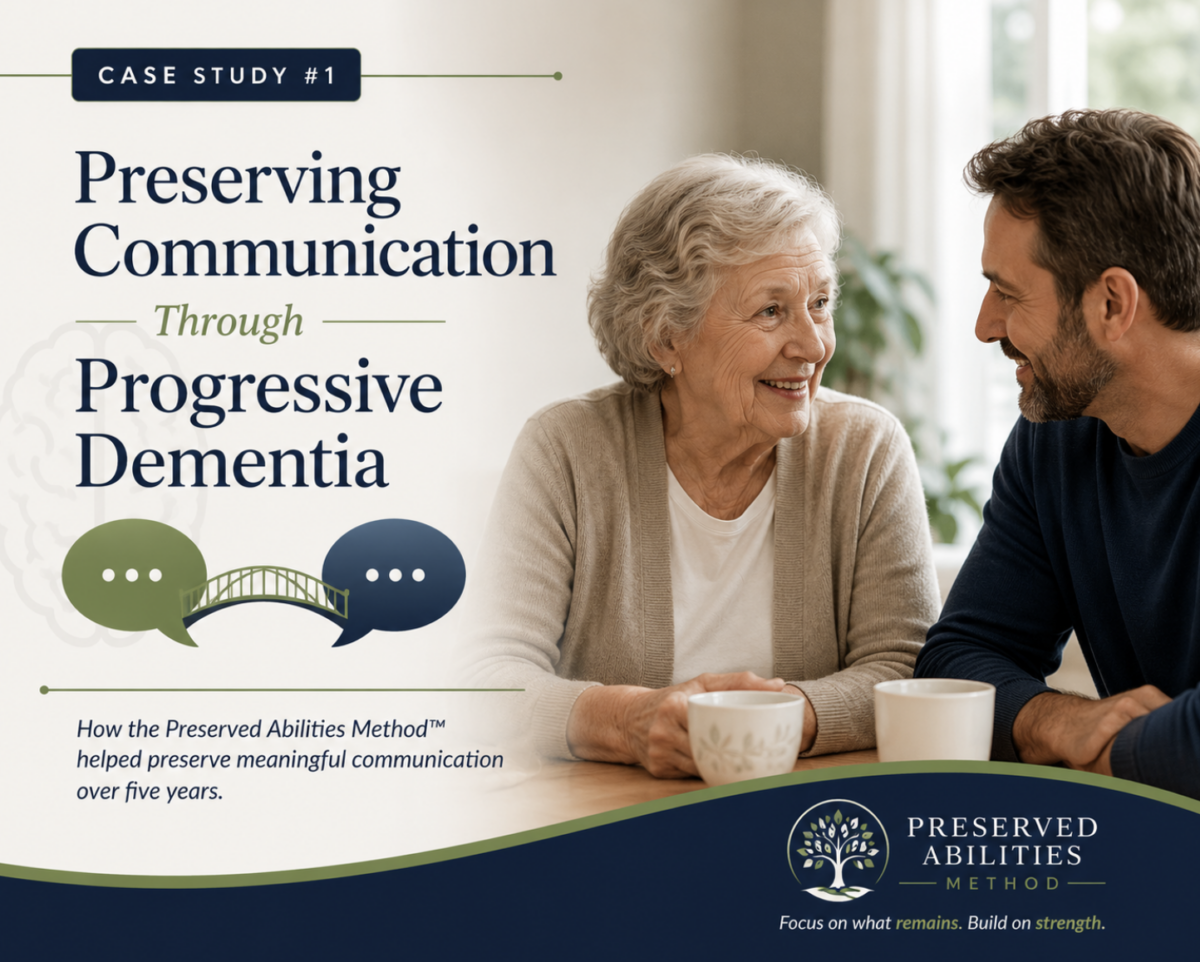
The Preserved Abilities Method™ helped this family identify and build upon a preserved verbal-linguistic ability, allowing meaningful communication and connection to continue throughout the progression of dementia.