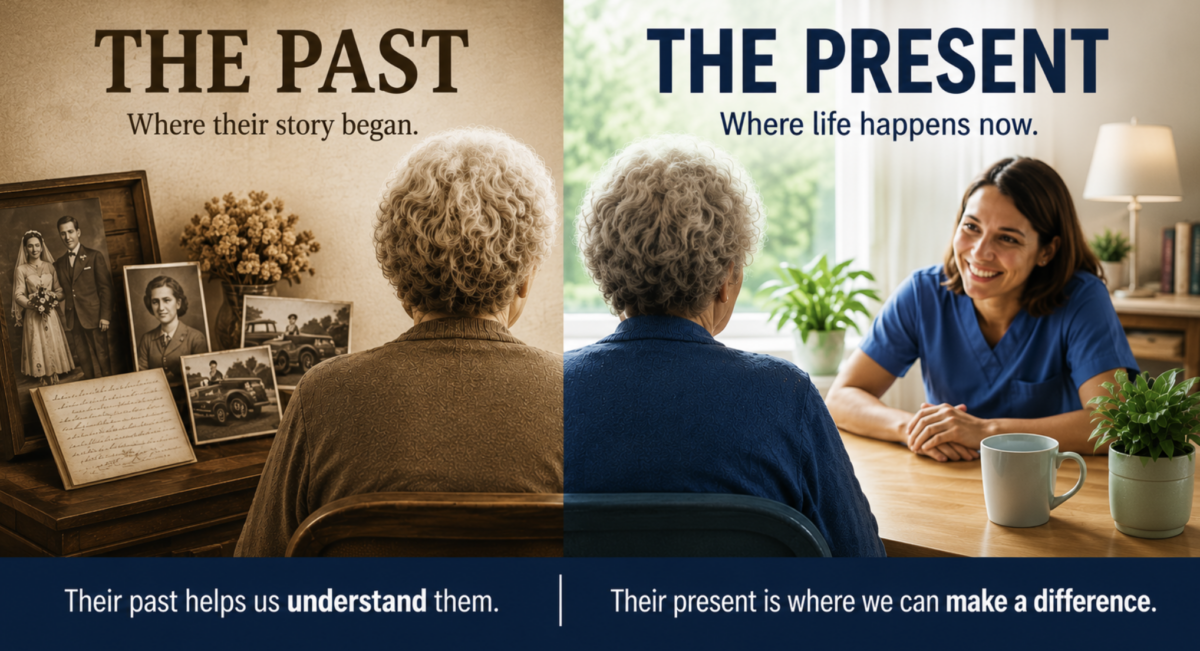
The past helps us understand the person. The present is where we can make the greatest difference.
One of the most common pieces of advice in dementia care is this:
“Learn the person’s life story.”
“Talk about their past.”
“Use reminiscence.”
“Create a memory box.”
There is value in all of those things.
But I wonder if we’ve unintentionally created a dementia care system that spends so much time looking backward that we sometimes stop seeing the person who is sitting in front of us today.
That’s a difficult question.
Because if we’re honest, many dementia care programs place enormous emphasis on the past.
We build memory boxes.
We decorate rooms with childhood photographs.
We create timelines.
We ask families to complete lengthy life histories.
We encourage conversations about decades ago.
We try to reconnect people with who they were.
Again…
None of those things are inherently wrong.
In fact, for many people they can be deeply comforting.
But what happens when they aren’t?
I’ve worked with many individuals living with dementia who no longer remember much of their past at all.
Yet families, caregivers, and professionals—often with the very best intentions—continue trying to pull them back into memories they simply no longer have.
“Remember when…”
“You used to…”
“Don’t you remember…”
Sometimes the person becomes frustrated.
Sometimes embarrassed.
Sometimes anxious because they feel they’re supposed to remember but can’t.
The conversation quietly becomes another reminder of what has been lost.
When Good Intentions Create Distress
I’ve even seen this mindset unintentionally create distress.
I was visiting a memory care community when I watched a staff member trying to help a woman take a shower.
The woman stood outside her bedroom and refused to go inside.
“That’s not my room,” she insisted.
The caregiver, trying to reassure her, pointed to a framed photograph sitting on the dresser.
“See? That’s your husband.”
The woman looked at the picture.
“That’s not my husband,” she replied.
Rather than accepting what the woman was experiencing in that moment, the caregiver tried harder.
“Yes, it is.”
“No, it isn’t.”
Back and forth they went.
The more the caregiver tried to convince her of her past, the more distressed the woman became.
Within moments, what had started as a simple shower had turned into an argument.
Voices became louder.
The woman became increasingly upset.
Additional staff were called to help.
Chaos ensued.
I’ve often wondered what might have happened if, instead of trying to prove who the man in the photograph was, we had focused on who this woman was in that moment.
She wasn’t asking for a history lesson.
She was telling us she didn’t feel safe entering that room.
Whether that room truly belonged to her wasn’t really the point.
The goal wasn’t to win the argument.
The goal was to help her feel safe.
Who Are We Really Caring For?
That experience raises an uncomfortable question.
Who are we doing this for?
Because if the goal is to improve a person’s quality of life, perhaps the more important question isn’t…
“Who were they?”
It’s…
“Who are they today?”
That doesn’t mean their history doesn’t matter.
It absolutely does.
A person’s past often helps us understand their values, preferences, routines, motivations, and—perhaps most importantly—their preserved abilities.
Someone who spent forty years teaching may still naturally guide and encourage others.
Someone who owned a restaurant may still feel compelled to organize meals.
Someone who raised six children may still instinctively nurture those around them.
Their history provides context.
But context is different from destination.
Too often, dementia care stops at learning the history.
What If We Used the Past Differently?
What if we used a person’s past not simply to reminisce…
But to discover what abilities are still alive?
Instead of asking someone to remember they were a gardener…
Invite them to care for plants.
Instead of asking someone to remember being an accountant…
Let them organize, sort, or solve simple problems.
Instead of repeatedly talking about the years they taught school…
Ask them to mentor, encourage, or help another resident.
Instead of trying to bring the past back…
Use the past to build something meaningful in the present.
That’s a very different philosophy.
The goal isn’t to recreate yesterday.
The goal is to improve today.
When we become too focused on recovering memories, we can accidentally overlook the preserved abilities that still exist right now.
A person doesn’t need to remember being an artist to enjoy painting.
They don’t need to remember being a musician to respond emotionally to music.
They don’t need to remember being a parent to comfort another person.
They don’t even need to remember their own history to have purpose.
Identity Is More Than Memory
Perhaps one of the greatest misconceptions in dementia care is believing that preserving identity requires preserving memories.
I don’t think that’s always true.
Sometimes identity lives in abilities.
In habits.
In values.
In personality.
In the ways people naturally interact with the world.
Those things often remain long after autobiographical memories begin to fade.
Perhaps that’s the shift dementia care needs most.
Not abandoning the past…
But changing why we use it.
The past should help us understand the person, identify their preserved abilities, and create opportunities for them to experience purpose, connection, and joy today.
Because while memories may fade…
The ability to live a meaningful life does not have to.
Perhaps the greatest tragedy isn’t that people living with dementia forget their past.
It’s that the rest of us become so focused on it that we forget to help them live today.
Because a person’s past should help us understand them…
Not define the limits of how we care for them today.
After all…
A meaningful life isn’t lived in the past.
It’s lived in the present.
Learn More About the Preserved Abilities Method™
The ideas shared in this article reflect the philosophy behind the Preserved Abilities Method™, an evidence-informed approach to dementia care that shifts the focus from what has been lost to what has been preserved.
Rather than asking, “What can this person no longer do?”, the Preserved Abilities Method™ asks, “What abilities remain, and how can we use them to improve everyday life?”
By identifying preserved abilities and using them to guide communication, activities, caregiving strategies, and the environment, we can create more meaningful experiences for people living with dementia while reducing distress for families and care partners.
Learn more at:
https://preservedabilities.com
As Featured in Newsweek
The philosophy behind the Preserved Abilities Method™ was recently featured in Newsweek in the article:
“Dementia Care Should Begin With What Is Preserved, Not What Has Been Lost.”
Read it here:
You May Also Like
- Are Dementia Behaviors Preserved Abilities in Disguise?
- Why Dementia Communication Strategies Often Miss the Mark
- Before We Ask “Can We Get Them Something?” Should We Ask “Why?”
- The Dementia Care System Doesn’t Just Fail People. It May Be Setting the Stage for Abuse and Neglect.