Exploring the need for practical, individualized methodologies in dementia care.
Dementia care has changed considerably over the years.
We understand more about the disease. We diagnose it earlier. New medications are being developed. Technology is advancing rapidly. Artificial intelligence, remote monitoring, robotics, smart-home systems, and other tools are beginning to play a larger role in supporting people living with dementia and those who care for them.
At the same time, the philosophy of dementia care has evolved.
We talk about person-centered care.
We talk about dignity.
We talk about meaningful engagement.
We talk about knowing the person rather than simply knowing the diagnosis.
These are important advances.
But I believe there is another question we need to be asking:
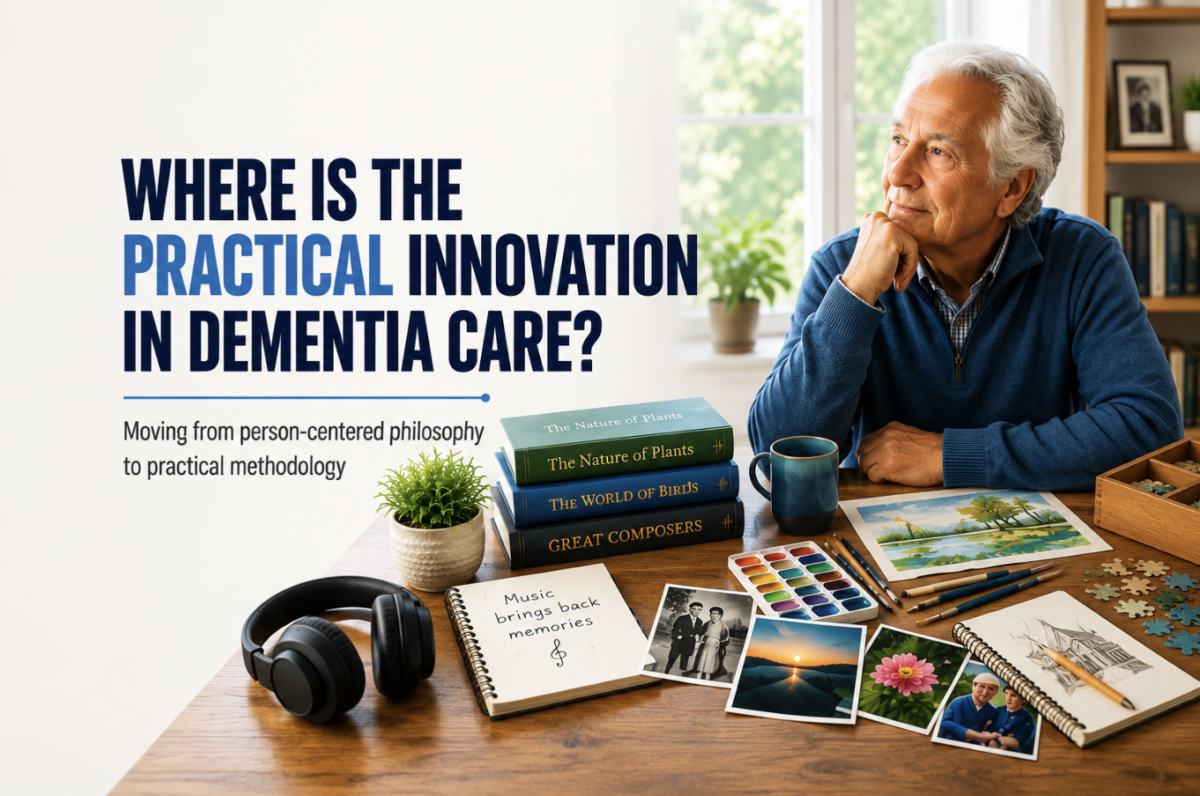
Where is the innovation in the practical methodologies caregivers use every day?
We Know What Good Dementia Care Should Look Like
Much of today’s dementia-care guidance points us in the right direction.
Caregivers are encouraged to avoid unnecessary confrontation, adapt communication, modify the environment, provide meaningful activities, and consider what an individual is still capable of doing.
These are sound principles.
The challenge is that principles do not always tell caregivers how to individualize them.
Two people with the same diagnosis and at a similar stage of dementia may have very different preserved abilities.
One may respond exceptionally well to music.
Another may have very little interest in music but remain highly social.
Another may retain strong visual-spatial abilities.
Another may retain an ability to organize, categorize, calculate, or problem-solve.
Another may prefer solitude, reflection, and familiar routines.
If we don’t have a structured way of identifying those differences, how do we consistently translate person-centered philosophy into individualized care?
Has Philosophy Outpaced Methodology?
This is where I believe dementia care has an opportunity to evolve.
We have become much better at describing what good care should look like.
But have we invested the same energy into developing practical methodologies that help caregivers determine how to provide that care for a particular individual?
There is an important distinction between a philosophy and a methodology.
A philosophy may tell us:
Focus on the person.
A methodology should help us answer:
What specifically should I do differently for this person?
That requires more than knowing someone’s diagnosis or stage of dementia.
It requires understanding the abilities, preferences, interests, history, and patterns that remain accessible to them.
Individualized Care Requires Individualized Information
One of the most common phrases in dementia care is:
“Meet the person where they are.”
I completely agree.
But to meet someone where they are, we first have to understand where they are.
What abilities remain strong?
How does this person best process and respond to information?
What kinds of activities are most likely to engage them?
What communication approaches are most likely to be successful?
What aspects of the environment might support—or interfere with—their remaining abilities?
These are practical questions.
And caregivers need practical ways to answer them.
Without that information, even well-intentioned person-centered care can become generalized.
We may know that we should provide meaningful activities, for example, but still end up offering many of the same activities to everyone.
We may know that communication should be individualized but still rely on the same communication techniques for people whose preserved abilities are very different.
The philosophy is individualized.
The implementation may not be.
Innovation Doesn’t Have to Mean More Technology
When we hear the word innovation, we often think about technology.
And technology absolutely has an important role to play in the future of dementia care.
But innovation does not always require a new device, artificial intelligence, robotics, or another digital platform.
Sometimes innovation can mean developing a better way to understand the person sitting in front of us.
It can mean creating structured methods for identifying preserved abilities.
It can mean translating those abilities into practical strategies caregivers can actually use.
It can mean helping caregivers move from:
“What has this person lost?”
to:
“What remains, and how can we use it?”
That shift may sound simple.
Putting it into practice consistently is not.
Why IntelliAbility Developed the Preserved Abilities Method™
This is the problem IntelliAbility, LLC has been working to address through the Preserved Abilities Method™.
The methodology grew out of years of direct work with people living with dementia and an observation caregivers see every day:
Cognitive decline is not uniform.
People do not lose every ability at the same rate.
Even when significant impairment is present, certain abilities may remain surprisingly strong.
The challenge is identifying those abilities systematically and then knowing what to do with that information.
The Preserved Abilities Method uses a structured assessment grounded in Harvard cognitive scientist Howard Gardner’s Theory of Multiple Intelligences to help identify areas of relative strength across eight abilities.
But identifying preserved abilities is only the beginning.
The purpose is to translate those findings into individualized communication approaches, environmental strategies, and meaningful activities that caregivers can use in everyday situations.
In other words, the goal is not simply to identify strengths.
It is to use them.
From Strength-Based Philosophy to Practical Methodology
Strength-based care is not a new idea.
For years, professionals have encouraged caregivers to focus on what a person can still do rather than concentrating exclusively on deficits.
That philosophy is important.
But saying “focus on strengths” and having a systematic way to identify and apply those strengths are two different things.
That distinction matters.
If we want strength-based and person-centered care to be consistently individualized, caregivers need more than a philosophy.
They need practical tools that help answer:
What are this person’s strengths?
How can those strengths influence the way I communicate with them?
How can I modify their environment to better support them?
What activities are more likely to be meaningful based on their preserved abilities?
How can I use those abilities during everyday care?
This is where practical methodology can strengthen what person-centered care has already accomplished.
The Next Evolution of Person-Centered Care
Dementia care does not need to abandon person-centered care.
Quite the opposite.
The next evolution of person-centered care may be developing more structured ways to put its principles into practice.
We should continue asking:
Who is this person?
What matters to them?
What is their history?
What do they enjoy?
But perhaps we should also be asking:
What abilities remain strongest?
How can those abilities guide the way we communicate?
How can they shape the person’s environment?
How can they help us create meaningful engagement?
How can caregivers use those abilities to make everyday care more successful?
A Question for the Dementia-Care Community
There has been extraordinary innovation in our understanding of dementia.
There has been extraordinary innovation in technology.
There has been extraordinary innovation in medicine.
But what about the practical methodologies caregivers use every day?
This is a conversation worth having.
Where are you seeing practical innovation in dementia care?
What new methodologies are helping caregivers translate person-centered philosophy into everyday practice?
And where do you believe we still have work to do?
Because sometimes innovation isn’t about creating something more complicated.
Sometimes it begins by looking at the person differently.
Not simply asking what dementia has taken away.
But asking what is still there—and what we can do with it.
The Preserved Abilities Method™ was created by IntelliAbility, LLC. It is an assessment-driven dementia-care methodology designed to identify preserved abilities and translate them into individualized strategies for communication, environment, and meaningful engagement.