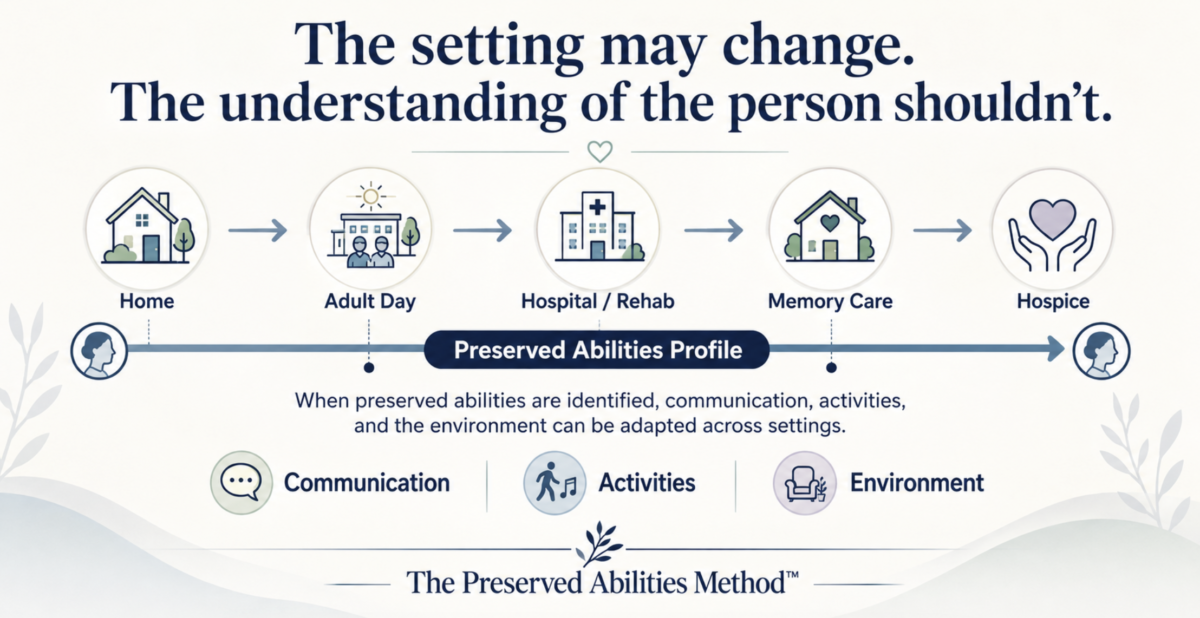
The setting may change, but the understanding of the person shouldn’t. A preserved abilities profile can help communication, activities, and environmental supports follow the individual across care settings.
People living with dementia often move through multiple care settings over the course of the disease.
They may begin at home.
Later, they may attend an adult day program, receive home-care services, spend time in a hospital or rehabilitation facility, transition to assisted living or memory care, and eventually receive hospice services.
Each transition can be difficult.
New surroundings.
New caregivers.
New routines.
New expectations.
For someone already experiencing changes in memory, orientation, communication, or processing, even a necessary transition can create significant confusion and distress.
We cannot always prevent these transitions.
But I believe we can do much more to make them easier.
And one of the most important things we can carry from one setting to another is an understanding of the person’s preserved abilities.
What Do We Usually Transfer?
When someone with dementia moves into a new care setting, we are usually very good at transferring certain information.
We transfer diagnoses.
We transfer medication lists.
We transfer medical histories.
We transfer fall risks.
We transfer notes about behaviors.
All of this information matters.
But there is another category of information that is often missing:
What still works for this person?
How do they communicate most successfully?
What types of activities naturally engage them?
What environmental cues help them understand their surroundings?
Do they respond particularly well to music?
Are visual cues especially helpful?
Do they thrive in social situations?
Do they respond well to routines, sequencing, movement, nature, or familiar language?
These things can be just as important to day-to-day care as knowing what the person can no longer do.
Continuum of Care Is Not the Same as Continuity of Care
There is an important distinction between the two.
The continuum of care refers to the different services and settings a person may encounter over time.
Home care.
Adult day services.
Hospitals.
Rehabilitation.
Assisted living.
Memory care.
Hospice.
But continuity of care is about what follows the person through that continuum.
It is the knowledge, understanding, and successful approaches that should not disappear simply because the person walks through a different door.
Unfortunately, this is often exactly what happens.
A family may spend years learning how to communicate successfully with their loved one.
An adult day program may discover which activities consistently result in meaningful engagement.
A home-care worker may learn that a particular environmental cue dramatically reduces confusion.
Then the person enters a new setting, and much of that knowledge is lost.
The new care team begins again.
For someone living with dementia, starting over can come at a significant cost.
Preserved Abilities Can Provide a Roadmap
This is one of the reasons I developed the Preserved Abilities Method™.
Rather than beginning primarily with deficits, PAM begins by identifying areas of relative strength that remain available to the individual.
Those preserved abilities can then help guide three major areas of care:
Communication
If we understand how a person best receives and processes information, communication can be adapted accordingly.
One person may respond particularly well to verbal explanation.
Another may benefit more from visual cues.
Someone else may engage most successfully through music, movement, or social interaction.
The more we understand about how the individual still connects with the world, the less we have to rely on trial and error.
Activities
Activities should not simply be chosen because they are labeled “appropriate for dementia.”
They should be matched to the individual.
Knowing a person’s preserved abilities can help caregivers identify activities that have a greater likelihood of producing engagement, success, and enjoyment.
And that information should travel with the person.
If a particular form of engagement worked at home, the adult day program should know about it.
If the day program discovers something new, the family should know.
If the person later moves into memory care, that knowledge should follow them there too.
Environment
The environment itself can either support a person or make functioning more difficult.
A person with relatively preserved visual-spatial abilities may benefit from well-designed visual cues, contrast, signage, pictures, and environmental landmarks.
Someone with stronger logical or sequencing abilities might benefit from objects being arranged in the order they are used or from simple step-by-step cues.
Another individual may function better in an environment that includes music, opportunities for movement, nature, or familiar social interaction.
There is no single “dementia-friendly environment” that will be ideal for everyone.
The environment should reflect the person.
Imagine a Different Kind of Transfer
Imagine someone living with dementia is admitted to the hospital.
Instead of the hospital receiving only:
Diagnosis: Dementia
Risk: Falls
Behavior: Becomes agitated
What if the care team also received something like this?
Relative strengths: Musical, interpersonal, and bodily-kinesthetic abilities
Helpful communication: Calm conversational approach, one person speaking at a time, responds well to familiar music.
Helpful engagement: Walking, rhythmic movement, singing familiar songs.
Environmental considerations: Becomes more distressed when isolated for long periods; benefits from social interaction and opportunities to move.
Now the care team has more than a list of problems.
They have a starting point.
They know something about how to reach the person.
That can make an enormous difference when everything else around that individual has suddenly changed.
The Setting May Change. The Understanding Shouldn’t.
Transitions will always be part of dementia care.
The goal is not to pretend we can eliminate all disruption.
The goal is to prevent unnecessary disruption caused by repeatedly losing what we have already learned about the individual.
Every caregiver should not have to rediscover the same person from the beginning.
Every new setting should not have to spend weeks determining what works.
If preserved abilities, successful communication strategies, meaningful activities, and effective environmental supports are identified and shared, the next care team can build on what is already known.
That is continuity.
The care setting may change.
The people providing the care may change.
The person’s needs may change.
But our understanding of the individual should not disappear every time they move through another door.
That is why I believe preserved abilities have an important role to play across the entire dementia-care continuum.
Because continuity of care should also mean continuity of understanding.
And the more we understand what remains, the better chance we have of helping the person continue to live successfully wherever care takes place.
Want to learn more about the Preserved Abilities Method™?
Discover how PAM helps families and professionals identify retained strengths and use them to guide communication, activities, and the environment.
Learn more about the Preserved Abilities Method™