
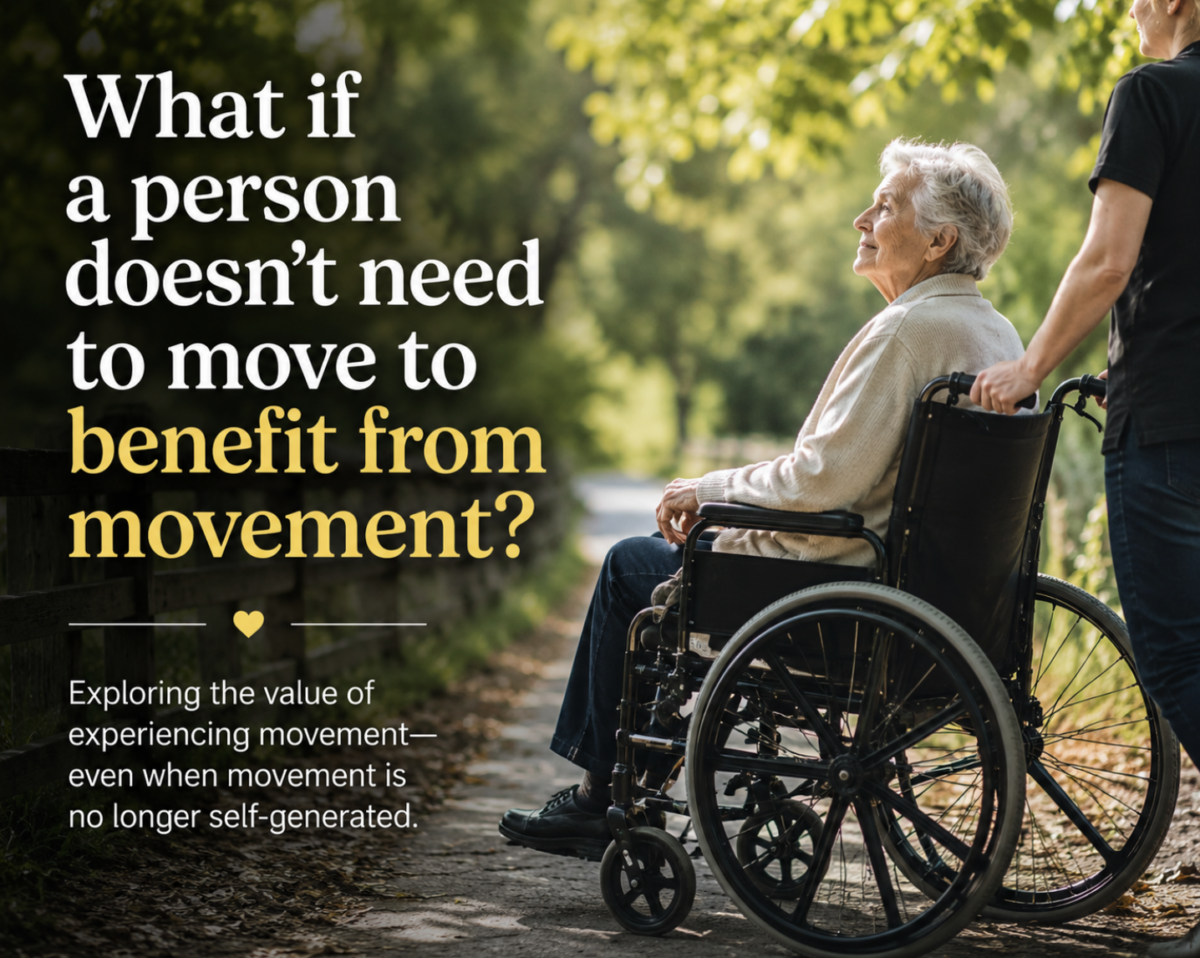
The inability to move independently does not necessarily mean movement has stopped being meaningful.
Throughout my career, I’ve worked with many individuals who spent much of their lives in motion.
Daily walkers.
Runners.
People who rarely sat still.
People who enjoyed exercising, working outdoors, exploring, and staying active.
Movement wasn’t simply something they did.
It was part of who they were.
Then they entered long-term care.
As dementia progressed and fall risk increased, many eventually found themselves spending most of their day in a wheelchair.
The decision was often made with good intentions.
Safety became the priority.
Preventing falls became the focus.
But over time, I began noticing something.
Many of these individuals appeared withdrawn while sitting.
Their affect was often flat.
They participated less.
Some seemed disconnected from the world around them.
Then something interesting would happen.
A staff member would push them down the hallway.
Take them outside.
Bring them to another part of the building.
Go for a walk around the courtyard.
And suddenly they seemed different.
They looked around.
They smiled.
They became more alert.
Some started talking.
Others simply appeared more engaged with their surroundings.
At first, I assumed it was the change of scenery.
And perhaps sometimes it was.
But after observing this pattern repeatedly over many years, I began to wonder if something else might be happening.
Are We Overlooking the Experience of Movement?
When we think about movement, we usually think about activities people perform.
Walking.
Dancing.
Exercising.
Stretching.
Moving from one place to another.
But what if movement is not only something we do?
What if movement is also something we experience?
Consider a passenger riding in a car.
A child on a swing.
Someone sitting in a rocking chair.
A person being pushed through a garden in a wheelchair.
None of these individuals are generating the movement themselves.
Yet they are still experiencing it.
They feel changes in direction.
Changes in scenery.
Changes in speed.
They experience movement through space.
Their bodies remain part of the experience.
The movement is happening to them rather than being created by them.
But does that make it any less meaningful?
Mobility and Movement Are Not the Same Thing
Perhaps one of the assumptions we make is that once a person loses mobility, movement-based engagement becomes less important.
But mobility and movement are not necessarily the same thing.
Mobility refers to a person’s ability to move independently.
Movement refers to the experience of moving through the world.
A person may lose the ability to walk.
That does not necessarily mean movement has stopped being meaningful.
In fact, for someone who spent a lifetime walking, running, hiking, exercising, pacing, or simply staying active, movement may have been one of their primary ways of experiencing life.
If that’s true, then losing mobility may involve more than the loss of a physical skill.
It may involve losing an important pathway for engagement.
A Different Way to View Bodily-Kinesthetic Ability
This observation has led me to think differently about Bodily-Kinesthetic ability.
Traditionally, we think of Bodily-Kinesthetic ability as learning through movement and hands-on experiences.
And certainly, active movement remains important whenever possible.
But what if there is another side to this ability?
What if some individuals continue to benefit from movement even after they lose the ability to create it themselves?
What if the experience of movement remains meaningful long after independent movement has been lost?
I don’t know the answer.
But I believe it is a question worth exploring.
The Connection to the Preserved Abilities Method™
One of the core principles of the Preserved Abilities Method™ is that we often focus on what a person can no longer do while overlooking what they may still be able to experience.
A person may no longer play an instrument but still respond deeply to music.
A person may no longer paint but still enjoy visual art.
A person may no longer garden but still find comfort in nature.
And perhaps a person may no longer walk independently while still benefiting from the experience of movement.
The more I think about it, the more I wonder if we sometimes mistake the loss of expression for the loss of ability.
Perhaps the inability to perform an action does not always mean the underlying pathway has disappeared.
Perhaps it simply means we need to find a different way to support it.
For some individuals living with dementia, a wheelchair ride may be more than transportation.
A trip outdoors may be more than a change of scenery.
Movement itself may still matter.
And if it does, that possibility is worth exploring.
Learn more about the Preserved Abilities Method™ at www.preservedabilities.com