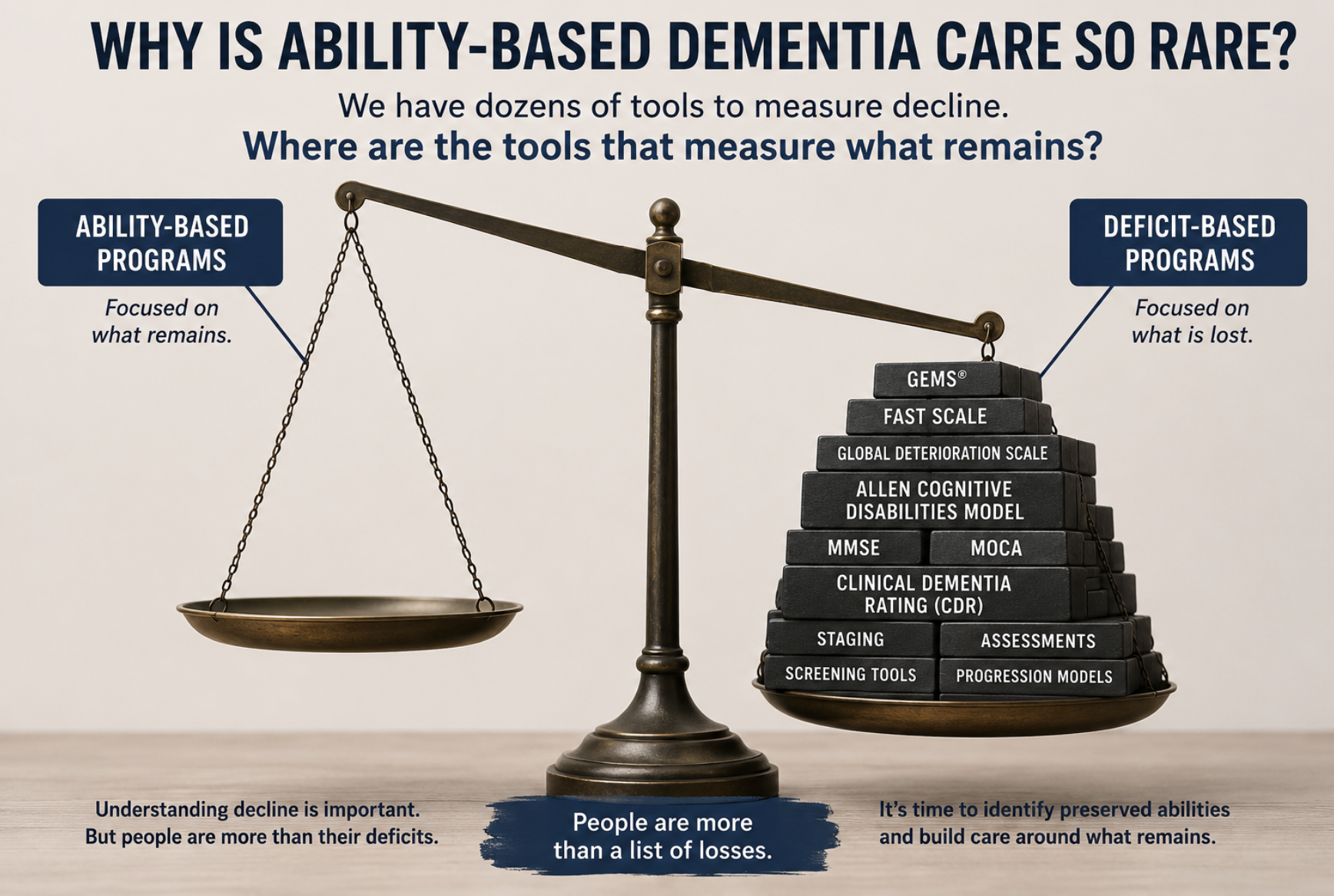
Why do we have so many tools to measure decline and so few to measure preserved abilities?
If this article makes some people uncomfortable, that’s okay.
I believe one of the biggest blind spots in dementia care is hiding in plain sight.
For decades, we have developed tools to measure decline.
We have tools to measure cognitive impairment.
We have tools to measure functional decline.
We have tools to stage dementia.
We have tools to assess severity.
We have tools to determine support needs.
But where are the tools designed to identify preserved abilities?
That question has bothered me for years.
As someone who has worked with people living with dementia in hospitals, rehabilitation centers, adult day programs, memory care communities, and private homes, I have seen firsthand that two people with similar diagnoses can respond very differently to the same support.
One person learns best through visual demonstration.
Another through conversation.
One becomes engaged through music.
Another through social interaction.
Another through movement.
Another through nature.
Yet much of dementia care continues to focus primarily on what has been lost rather than systematically identifying what remains.
The Deficit-Based Foundation of Dementia Care
To be clear, understanding decline is important.
Families need to understand risks.
Professionals need to understand support needs.
Care plans must address challenges.
The problem is not that we measure decline.
The problem is that we measure decline so extensively while giving comparatively little attention to measuring preserved abilities.
Consider some of the most widely used frameworks and assessment tools in dementia care:
| Framework | Primary Focus |
|---|---|
| GEMS® | Understanding changes in abilities caused by dementia |
| FAST Scale | Measuring functional decline over time |
| Global Deterioration Scale | Staging cognitive decline |
| Allen Cognitive Disabilities Model | Determining cognitive level and support needs |
| MMSE | Measuring cognitive impairment |
| MoCA | Screening for cognitive impairment |
| Clinical Dementia Rating (CDR) | Measuring severity of dementia |
Notice something?
Every framework listed above helps us understand dementia.
None were specifically designed to identify preserved abilities.
These frameworks help answer questions such as:
- How severe is the dementia?
- What abilities have declined?
- What level of support is needed?
- How has the condition progressed?
Those questions matter.
But they are not the same as asking:
- What abilities remain strongest?
- How does this person learn best?
- What communication approach is most effective?
- Which activities are most likely to create success?
- How can retained abilities be used to support daily life?
But Isn’t GEMS Strength-Based?
This is one of the most common responses I hear.
And I understand why.
GEMS encourages caregivers to look beyond deficits and adjust their support based on a person’s current abilities. That is valuable and has helped many caregivers better understand dementia.
However, understanding changing abilities is not the same as systematically identifying preserved abilities.
For example, two people may fall into the same category within a dementia framework and still have dramatically different strengths.
One may retain strong musical abilities.
Another may retain strong visual-spatial abilities.
Another may remain highly interpersonal.
Another may continue to respond best to verbal communication.
Another may learn best through movement and hands-on experiences.
Most dementia frameworks were not designed to identify these differences in a structured way.
That distinction is important.
Understanding dementia and identifying preserved abilities are not the same thing.
A Question We Rarely Ask
If dementia care is truly person-centered, shouldn’t we have a reliable way to identify these differences?
For years, I have watched caregivers, therapists, and activity professionals rely on trial and error.
They try one activity.
Then another.
Then another.
Sometimes they find something that works.
Sometimes they don’t.
What if we spent less time guessing?
What if we had a structured way to identify which abilities remain strongest and use those abilities to guide care?
Ability-Based Care
Ability-based care begins with a different assumption.
It assumes that even when dementia causes significant decline, important abilities often remain.
The challenge is identifying them.
A person may retain strong verbal-linguistic abilities.
Another may retain strong visual-spatial abilities.
Another may continue to rely heavily on interpersonal relationships.
Another may remain highly responsive to music.
Another may learn best through movement and hands-on experiences.
When caregivers understand these preserved abilities, communication, activities, environmental supports, and daily interactions can be tailored accordingly.
The goal is not to ignore deficits.
The goal is to stop allowing deficits to become the entire story.
Why This Matters
Imagine if education focused exclusively on what students struggled to do.
Imagine if rehabilitation focused exclusively on what patients had lost.
Imagine if therapy plans were built without considering a person’s strengths.
Most professionals would immediately recognize the limitations of those approaches.
Yet dementia care often remains heavily centered on deficits.
We have become incredibly skilled at measuring decline.
Far less attention has been given to systematically identifying retained abilities.
I believe that is one of the biggest blind spots in modern dementia care.
The Future of Dementia Care
Understanding decline will always be important.
Families need to know what support is required.
Professionals need to understand safety concerns.
Care plans must address challenges.
But what if identifying preserved abilities became just as routine as identifying impairments?
What if every care plan included not only a description of challenges, but also a clear understanding of the abilities that remain strongest?
What if caregivers were trained not only to manage decline, but also to leverage retained abilities?
What if we stopped viewing preserved abilities as something we occasionally notice and started treating them as something worth measuring?
The question is not whether dementia causes decline.
The question is why we have built so many systems to measure loss while creating so few systems to identify what remains.
Until that changes, ability-based dementia care will likely remain the exception rather than the rule.
And perhaps that is the question our field should be asking.
Why is ability-based dementia care still so rare?
Learn More
The goal of ability-based dementia care is not to replace existing frameworks or ignore the realities of dementia.
Understanding decline will always be important.
But perhaps it is time to give equal attention to identifying what remains.
Because when caregivers understand a person’s preserved abilities, communication becomes more effective, activities become more meaningful, and support can be tailored to the individual rather than the diagnosis.
If ability-based dementia care is going to become more common, that conversation has to start somewhere.
Learn more about the Preserved Abilities Method™ and the M.I. Care Survey & Plan™ at:
https://preservedabilities.com
#DementiaCare #AlzheimersCare #MemoryCare #DementiaEducation #PersonCenteredCare #PreservedAbilities #CaregiverSupport #SeniorCare #AgingServices #OccupationalTherapy #HealthcareInnovation #DementiaTraining